> daily_signal(2026_09_03)
This week the government stopped refereeing AI and picked sides: for OpenAI over the newspapers, a leak-hunting surveillance tool, AI rules in Florida schools, and a $98.5M rare-disease bet.
PickBits Daily Signal · Wednesday, September 3, 2026
// tl;dr
- The Justice Department filed on the side of OpenAI and Microsoft against The New York Times, arguing that training AI on copyrighted work is fair use. It is the government's first move in the AI-copyright fight we've tracked all summer, and it landed on the labs' side, calling AI training a "transformative use" that qualifies as fair use.
- A leaked ICE memo shows the agency paying cybersecurity firm ZeroFox $15 million to scrub its agents' names and addresses off data-broker sites, the dark web, and social media. A security expert warned the same tool could be run as a honeypot to unmask whistleblowers. ZeroFox once flagged peaceful Baltimore protest organizers as "threat actors."
- Florida's Board of Education votes September 16 on a rule forcing every K-12 district, charter, and all 28 state colleges to adopt an AI policy by July 1, 2027. It mandates parental notice and opt-outs, extra reviews for the youngest grades, 30-day retention of student-AI chats, and a ban on training commercial models on student data.
- ARPA-H announced RAPID, investing up to $98.5 million over four and a half years in AI to shorten rare-disease diagnosis. More than 350 million people live with one of over 10,000 rare diseases, only about 5% of which have an approved treatment, and the average patient spends six years on a "diagnostic odyssey." Awardees include UNC, Sage Bionetworks, and Probably Genetic.
For most of this year the government stayed out of the AI fights. The newspapers sued OpenAI; Sony and Warner sued Anthropic over music, a story we covered barely a week ago; the Isbell case went after Suno. This week it stopped watching. In a Manhattan courtroom the Justice Department filed on the side of OpenAI and Microsoft, arguing that training a model on copyrighted work is fair use, the first time Washington has taken a public position in any of it. It didn't split the difference. It sided with the labs.
The rest of the day keeps landing on the same question: who gets to decide what AI does to you. ICE is paying a firm to erase its agents from the internet with a tool its own officials warn could be turned around to hunt the people who leak. Florida is about to make every school in the state write down its rules for the classroom. Then, at the end, something that breaks the pattern: the federal government spending real money to point AI at a problem that has nothing to do with power over anyone, the six years a rare-disease family loses just getting a diagnosis. We save that one for last on purpose.
Washington entered the AI-copyright fight on the labs' side, ICE bought a machine that erases people, Florida started an AI-policy clock, and ARPA-H put $98.5 million behind ending the diagnostic odyssey.
1. The Justice Department told a federal court that training AI on the news is fair use.
It is the first time Washington has taken a side in the copyright fight, and it took the labs'.
When the government wants a say in a lawsuit it is not a party to, it files a statement of interest. On September 2, the Justice Department filed one in the Southern District of New York, backing OpenAI and Microsoft in the consolidated copyright suit brought by The New York Times, other newspapers, authors, Tribune Media, Ziff Davis, and The Intercept. Its argument: training the models on that work was a "transformative use" that qualifies as fair use, and the country has "a strong interest in continuing to develop a robust and competitive artificial intelligence industry." Associate Attorney General Stanley Woodward Jr. called it "a historic statement of interest."
This is the copyright arc we've tracked all summer, from Sony and Warner's suit against Anthropic to the newspapers against OpenAI. What changed this week is who's in the room. The plaintiffs aren't going quietly. But a statement of interest doesn't decide a case. The judge still rules. What it does is tell the court where the executive branch wants this to land, on the reading that treats a model reading your work as fair game. Matt Topic, counsel for The Intercept, called an adverse ruling "an unprecedented, uncompensated transfer of IP rights from news organizations to tech companies."
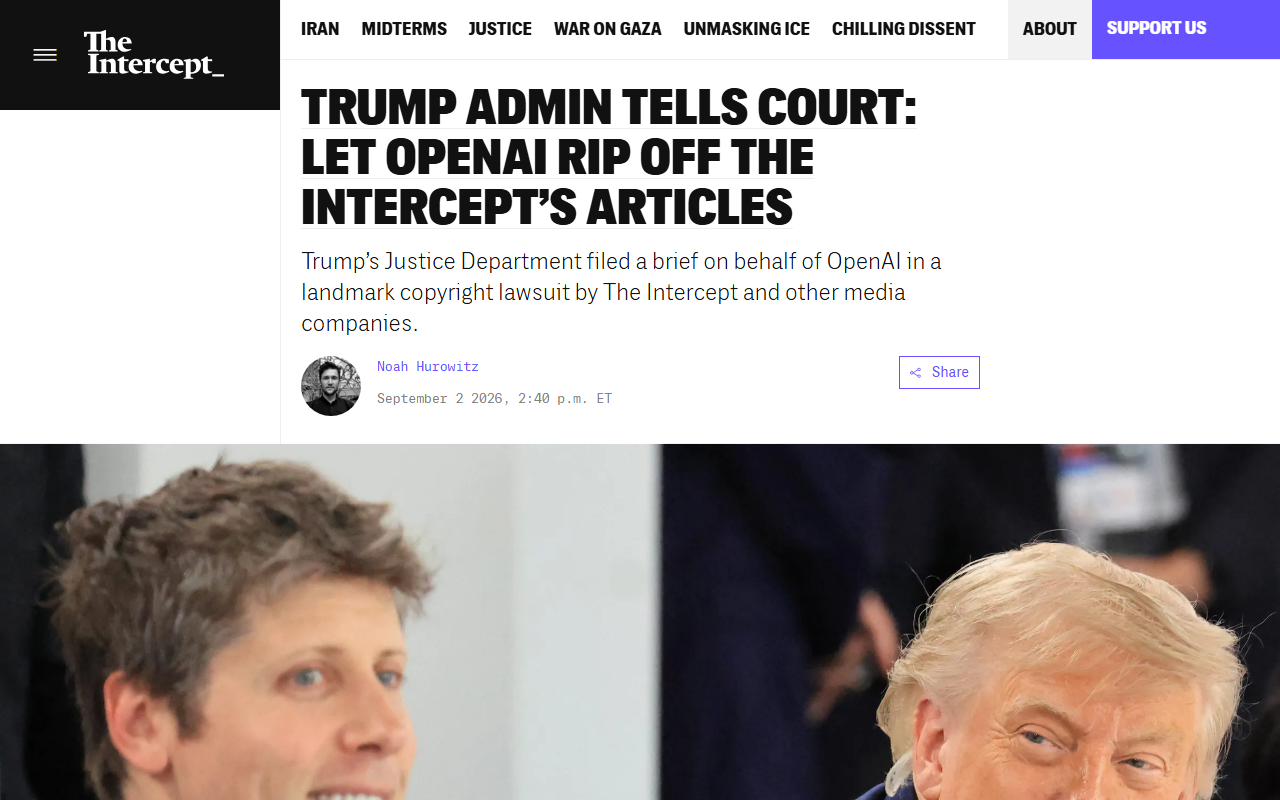
Why this matters: If you write, shoot, or record for a living, the government just argued in federal court that the moment your work goes online, it is fair game to train on. A statement of interest isn't a verdict, but it's the executive branch putting its thumb on the side of the scale that treats the open web as free training data, in the case most likely to set the precedent every other creator's suit gets measured against. The New York Times put it bluntly: the administration is "siding with a handful of trillion-dollar AI companies at the expense of the countless American creators whose work they stole."
Action this week: Read what rights your platform's terms of service already claim over what you post, before this argument hardens into precedent. My own read is that the licensing line, not the SDNY docket, is where an individual creator still has any leverage, because a fair-use ruling would quietly make the terms you already agreed to the whole ballgame. Follow this one; it is the case that decides whether the open web is training data.
2. ICE is paying ZeroFox $15 million to erase its agents from the internet.
A leaked memo says the same tool could be pointed inward to hunt whistleblowers.
Fifteen million dollars is what the Department of Homeland Security routed to a cybersecurity firm called ZeroFox this summer, and it surfaced only because a memo leaked. Signed by acting ICE director David Venturella, the leaked memo describes a "Doxing Mitigation Initiative": AI that scrubs ICE personnel's names and home addresses off data-broker sites, monitors social media and the dark web, and runs takedowns through a "Global Disruption Network." Records show DHS awarded ZeroFox a roughly $15 million contract in July 2026, routed to ICE's Homeland Security Investigations intelligence office.
If you've ever paid a service to pull your own name off a hundred people-finder sites, you already know the machine; this is that machine, bought at government scale. And the memo carried its own warning: security expert Richard Forno cautioned that leadership could seed its own leaks and run the same find-and-delete engine as a honeypot to identify whichever employee talked to a reporter. The direction of the tool is the only thing that changes; the capability is identical. Worth remembering: ZeroFox is the same company that flagged peaceful Black Lives Matter organizers in Baltimore as "threat actors" back in 2015.
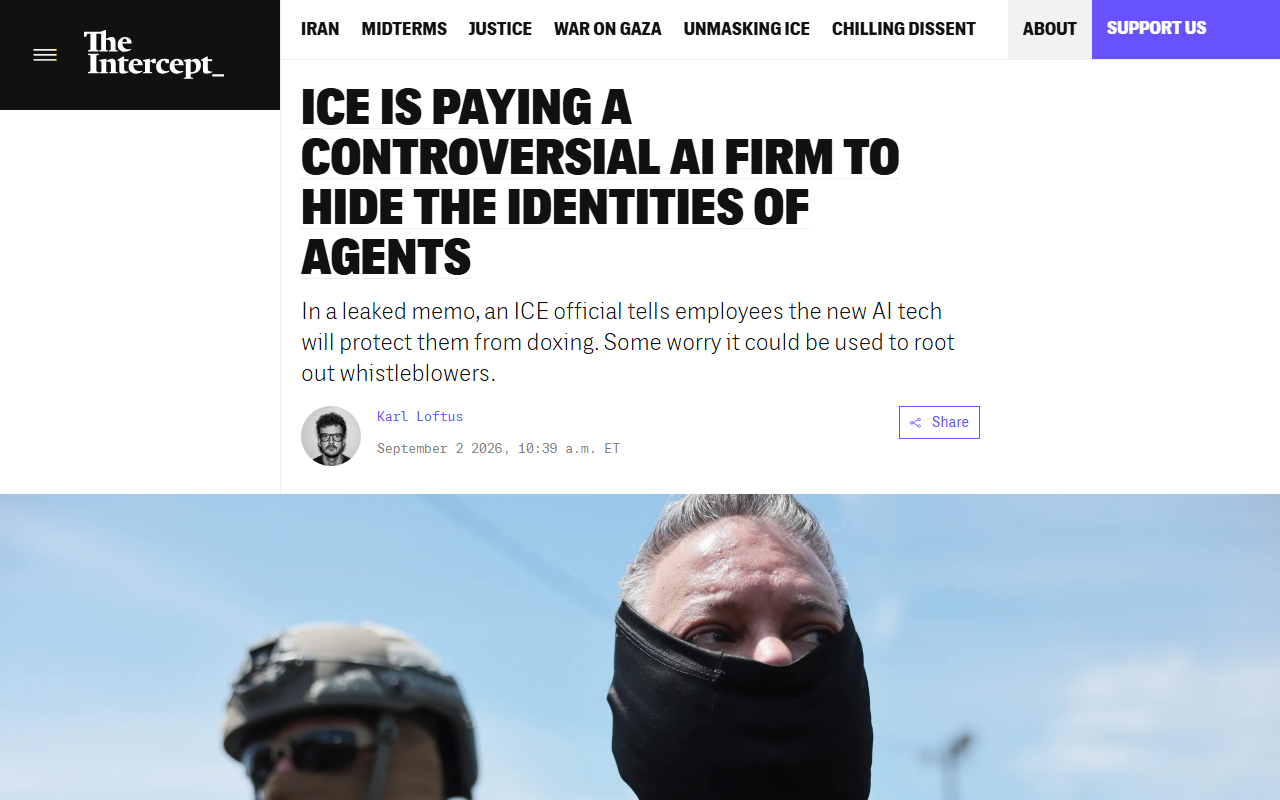
Why this matters: ICE is paying an AI fifteen million dollars to erase its agents from the internet, and its own people say that same machine can be pointed at leakers. The tool that hides a person and the tool that hunts a person are the same tool, and right now no public rule says a takedown network bought to protect agents can't be aimed at the people those agents answer to. The memo raised that risk deliberately, because someone inside was worried enough to write it down.
Action this week: Watch who files the records request and who asks to see the contract terms, because this reached daylight through a leak and a reporter, not an oversight hearing. When I've watched surveillance tools get repurposed before, the tell was never the launch memo; it was the quiet second use nobody had to disclose. Follow the paperwork, because the paperwork is the only thing standing between "protect our people" and "find the leaker."
PickBits Daily Signal is free. If it lands in your inbox every day and it is worth something to you, the best way to support it is to forward it to someone who would read it. Subscribe today!
3. Florida votes September 16 on making every school write an AI policy.
Districts, charters, and all 28 state colleges would have until July 2027 to comply.
If you run a school district, sit on a charter board, or sell software to either, September 16 just went on your calendar. That is the day Florida's Board of Education votes, at Polk State College, on a proposed rule requiring every K-12 public and charter school and the 28-college Florida College System to write and adopt an AI-use policy, with a hard deadline of July 1, 2027. The rule is specific about what the policy has to contain. Schools must notify parents of every teacher-approved AI tool, the platform, the classes, and what it does with a student, and give parents a way to opt out and receive a non-AI alternative. Tools for PreK-5 get extra age-appropriateness reviews. Student-AI interactions must be kept at least 30 days.
Two lines will gate every edtech contract signed in the state: no AI standing in for a teacher's judgment or simulating friendship or an emotional relationship with a student, and no harvesting student data to train commercial AI models. Separately, the Board of Governors will require university syllabi to disclose permitted AI use. Schools have spent three years improvising this one classroom at a time, a scramble we covered when districts were still just blocking chatbots and teachers were writing their own catch-a-cheater rules. Florida wants to replace the improvising with a filing requirement, and notably, Florida Education Association president Andrew Spar backed the student-protection goal, so the fight isn't whether to write the policy.
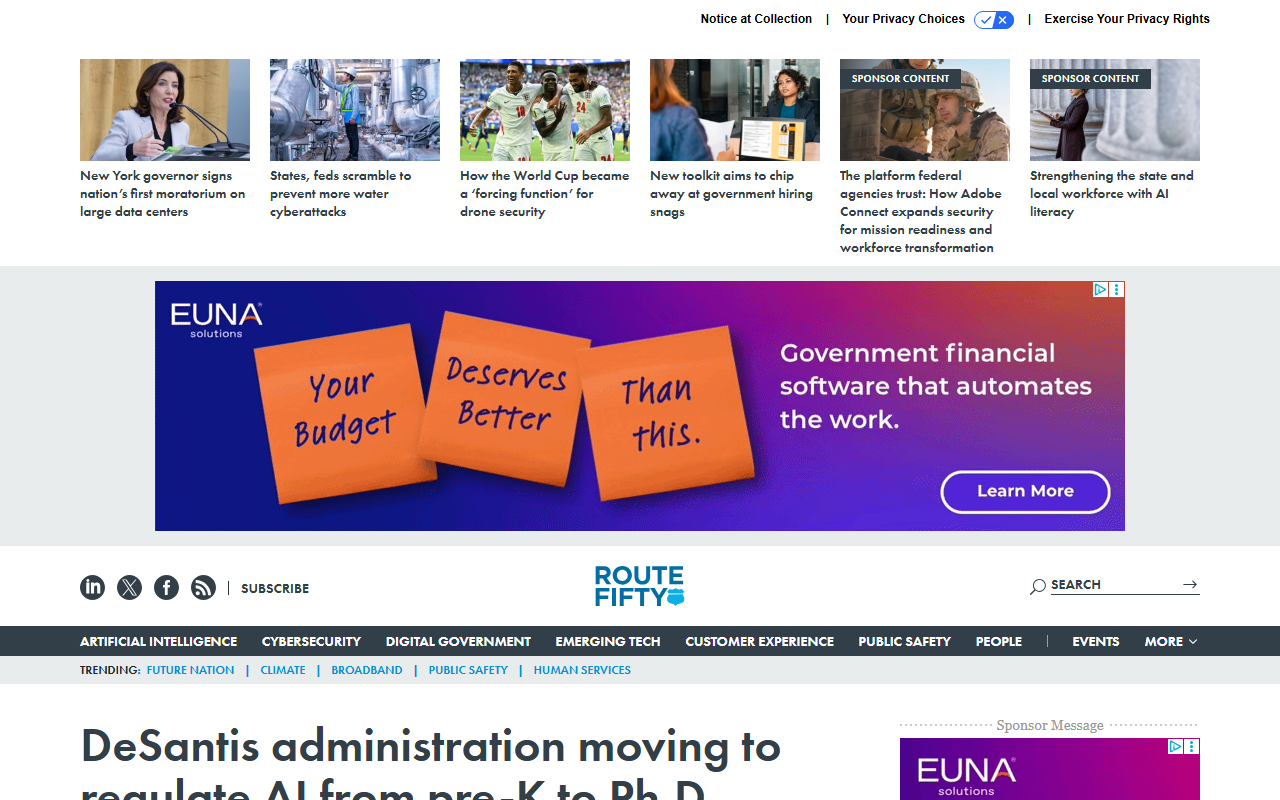
Why this matters: If you run a school district or sell software to one, Florida just put the AI policy you will have to write on a deadline: adopt one by July 1, 2027. A policy nobody has to follow is a press release; a rule with a deadline is a budget line. Every district AI policy in the country tends to copy the first few that ship, so what Florida writes down will not stay in Florida.
Action this week: Put one question to your edtech vendors in writing before you renew anything: do you train on student data, and can you prove the opt-out actually routes a kid to a real alternative? I've asked vendors that before, and "we take privacy seriously" isn't an answer; a signed data-processing addendum is. Send this to whoever signs your edtech contracts, because the second line of that rule is a clause they will have to meet.
route-fifty.com: DeSantis administration moves to regulate AI from pre-K through PhD (August 2026)
4. The government put up to $98.5 million into AI to shorten the rare-disease wait.
The average diagnostic odyssey runs six years; ARPA-H's RAPID is aimed straight at it.
Picture spending six years, appointment after appointment, ER visit after ER visit, and still not having a name for what's wrong with your own child. Six years is the average a rare-disease patient waits just to get a diagnosis. On August 31, ARPA-H, the health department's advanced-research arm, announced RAPID (Rare Disease AI/ML for Precision Integrated Diagnostics), investing up to $98.5 million over four and a half years to build AI-ready genomic datasets and diagnostic tools that shorten time-to-diagnosis and chase the biology behind diseases the market has always skipped. The scale is hard to hold: more than 350 million people live with one of over 10,000 rare diseases, and only about 5% have an approved treatment.
This isn't theoretical, which is what makes it worth ending on. Back in July we covered AI models rereading rare-disease cases specialists had given up on and finding answers for families who had waited years for one. That was the proof of concept; this is the money behind it. The honest caveat is that the money is announced and awarded, to the University of North Carolina, Sage Bionetworks, FDNA, and a patient-driven startup called Probably Genetic (up to $10M), but it has yet to reach an exam room. Funded is not running. Program manager Scott Gorman called rare-disease diagnosis "one of the greatest unmet needs in medicine," which is true, and also the kind of line that gets said at the start of a long build.
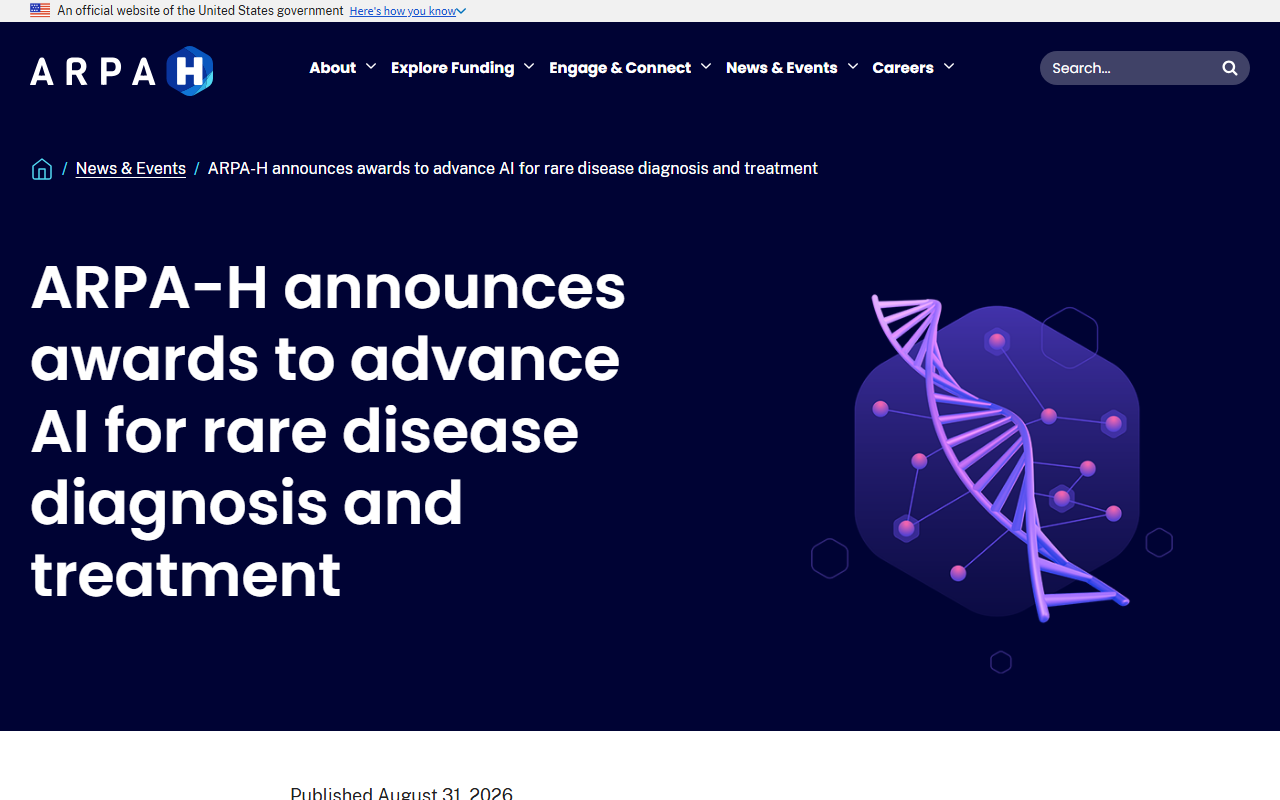
Why this matters: Families spend six years finding out what is wrong with their child, and the government just bet $98.5 million that AI can cut that down. A program that shortens the odyssey by even a year gives back time these families never get otherwise, and it is a rare case of government AI money aimed at helping people rather than tracking them. The risk is the ordinary one for any moonshot: the press release lands years before the tool does.
Action this week: Send this to anyone you know stuck on a diagnostic odyssey, then watch whether RAPID ships datasets other hospitals can actually use, the way one children's hospital is already giving its own rare-disease AI away for free. My read is that the science is real and the open question is delivery, not possibility; we've already seen a model crack cases specialists abandoned, so the thing to hold ARPA-H to is a working tool rather than another announcement.
» What to watch this week
- Whether the SDNY judge gives the DOJ's fair-use position any weight in the eventual ruling. The filing is not binding on the judge, but if the court picks up its reasoning, every parallel creator suit gets measured against it.
- Whether anyone with subpoena power asks ICE to show the ZeroFox contract and the rules governing who the tool can be pointed at. The memo proves the tool exists and warns how it could be misused; whether it ever gets pointed at leakers is the part no leak can show.
- The September 16 Florida vote itself. If it passes as written, districts have until July 1, 2027 to comply, and other states will have a template to copy well before then.
- Whether ARPA-H's RAPID awardees publish datasets and tools other hospitals can use, or the money produces papers instead. The tell over the next year is a clinic somewhere shortening a real diagnosis, not another funding announcement.
Tomorrow's signal lands here.