> daily_signal(2026_10_20)
New York wants algorithmic price tags to confess, scammers cloned a sheriff's voice, a startup raised $1.5 billion against the GPU bottleneck, and an AI found 45,500 people before Ebola could.
PickBits Daily Signal · Tuesday, October 20, 2026
// tl;dr
- New York's first-in-the-nation surveillance-pricing law reached a federal appeals court this week. The National Retail Federation is trying to kill a rule forcing any store to print "THIS PRICE WAS SET BY AN ALGORITHM USING YOUR PERSONAL DATA" when it prices you individually. Its own lawyer, pressed on accuracy, called the mandated sentence "literally true, but misleading."
- Police say scammers cloned the voice, and used the photo, of a real Florida sheriff to leave a resident a fake jury-duty voicemail. It is the home-phone version of the same voice-clone trick that helped move $108 million out of a bank this year, and the part that used to tell you a call was real, the familiar voice, is now the trick.
- Tenstorrent, Jim Keller's US chip startup, raised $1.5 billion at a $6.2 billion valuation to scale processors built on the open RISC-V standard instead of proprietary GPUs. It is aimed at the one risk under almost every AI plan: depending on a single chip supplier.
- Google says its Earth AI prototypes located 48 exposed settlements and more than 45,500 at-risk people during the DRC's Ebola outbreak, in minutes. That mapping work normally takes responders weeks, and the same geospatial method is already being tested to sharpen US county vaccination estimates.
The story I keep coming back to today is the one about price tags. We've been following surveillance pricing since the spring, when the first state bills turned up trying to force stores to admit when an algorithm set your price from your own data, and this week one of those laws reached a court that can actually settle it. New York wants a plain label on the tag, and retailers are in federal court right now trying to kill it.
A label is about the smallest thing you can ask a company to admit, so if they'll spend this much to stop it, I don't love the odds on the harder fights behind it, the liability and the refunds and the rules with real teeth. The rest of today, the cloned sheriff, the chip money, the Ebola maps, are worth your time too, but that price tag is the one I'd keep a tab open on.
The retailers' own lawyer called the warning "literally true, but misleading," which is the whole fight in five words.
1. New York wants every store to confess when an algorithm priced you from your own data.
The retailers took that fight to a federal appeals court on Monday, after their own lawyer conceded the mandated warning is "literally true, but misleading."
We have been tracking surveillance pricing since the spring, when the first wave of state bills set out to force stores to admit when they set an individual's price from personal data; more than 40 such bills landed across two dozen states this year, and RealPage-style rent-setting software drew its own bans. New York's Algorithmic Pricing Disclosure Act is the first to make the practice visible at the shelf: if a retailer used your purchase history, location, or loyalty profile to set the number on the tag just for you, it must display the all-caps notice "THIS PRICE WAS SET BY AN ALGORITHM USING YOUR PERSONAL DATA," enforceable by the attorney general (Letitia James) at up to $1,000 a violation.
The National Retail Federation sued and lost hard below: US District Judge Jed Rakoff dismissed its First Amendment claim with prejudice. On Monday, the group argued its appeal before a three-judge Second Circuit panel, and the hearing turned on one admission. Pressed on whether the compelled sentence is accurate, NRF lawyer David Gossett called it "literally true, but misleading," which is close to the whole case in five words: a store insisting it shouldn't have to say a true thing about how it priced you. Enforcement is paused while the appeal runs, so the panel's ruling, not the statute, is now the decisive test.
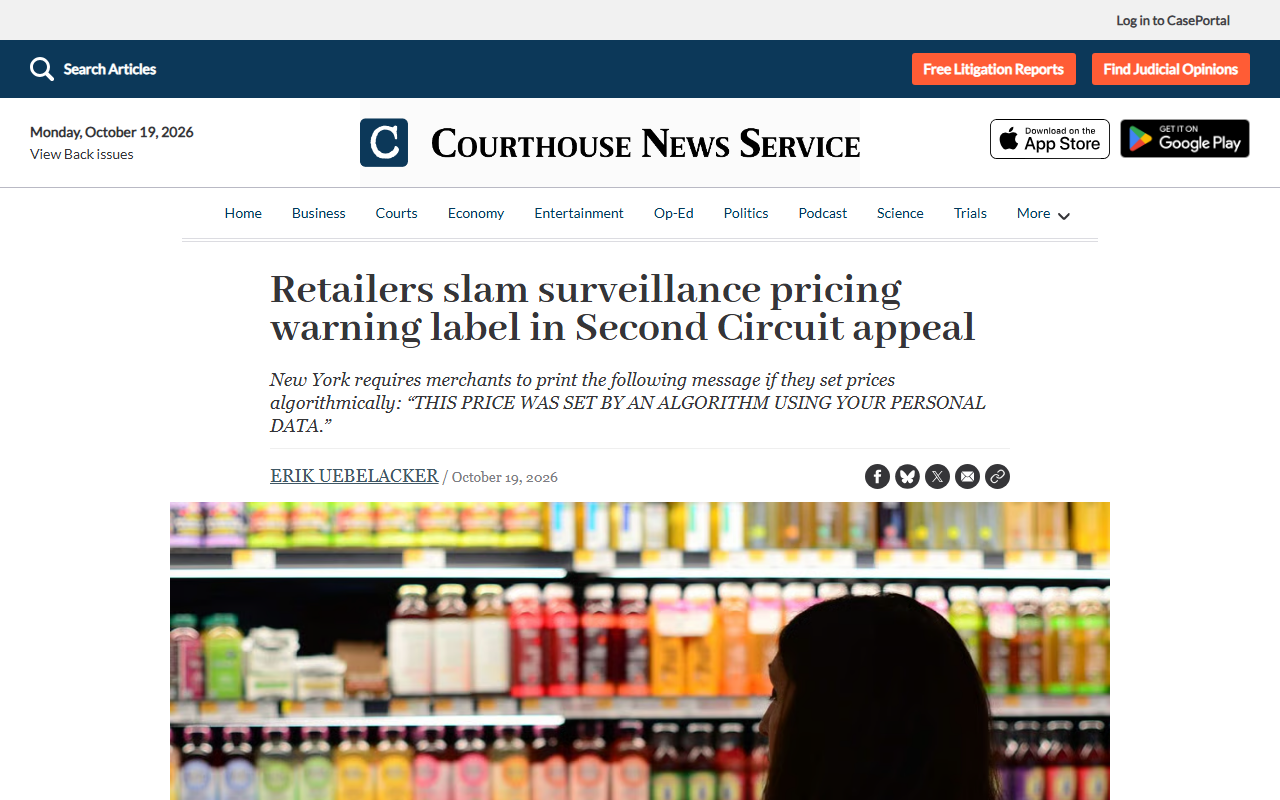
Why this matters: The next time a price in New York looks oddly personal, there may soon be a label telling you an algorithm set it from your data, and this appeal decides whether that label ever exists. Whatever this panel decides becomes the template. If the label survives, two dozen states copy New York's exact words within the year. I think the retailers have a real shot at killing it, though, and if they do, that label is dead nationwide before most shoppers knew it was even up for debate.
Action this week: Watch the Second Circuit docket, National Retail Federation v. James, because that panel is quietly deciding whether you ever get told a price was built from your data. If you set pricing for a company that does business in New York, map which of your engines consume personal data and where you'd have to put the label now, not after the ruling lands. Honestly, I'd bet the retailers win the legal argument more often than they should, so I wouldn't wait on the court to set my own policy.
courthousenews.com: Retailers slam surveillance pricing warning label in Second Circuit appeal (October 19, 2026)
retailbrew.com: NRF's lawsuit against New York's surveillance-pricing law sets the stage for a battle over fairness (2025)
2. Scammers cloned a sitting Florida sheriff's voice to run the jury-duty scam.
Police say the callers used Sheriff Steve Moser's real voice and photo, the newest turn in a voice-clone fraud wave we have followed all year.
Scammers used AI to clone the voice, and used the photo, of Osceola County, Florida Sheriff Steve Moser, police say, leaving a resident a voicemail impersonating him as part of the rising wave of fake jury-duty and arrest-warrant calls. A neighboring sheriff flagged the case, and then comes the same script scammers always run: you missed jury duty or have a warrant, and you have to pay right now by gift card, wire, or crypto.
This has gotten easier to pull off all year. The number earlier in 2026 was roughly one in four Americans reporting a deepfake voice call, with FBI tracking elderly losses in the billions. What changed here is whose voice it is: a real sheriff, someone the county knows by name. The reflex that kept you safe, I know that voice, is exactly what the scammer is renting now. It is the same technique, scaled down, that reportedly helped trigger a $108 million bank transfer this year on a cloned law firm partner's voice, and you can't fully trust your own ears on a phone call anymore.
Why this matters: That voicemail from the sheriff about your missed jury duty can now be an AI clone of his real voice, and the fact that you recognize it is exactly the point. What used to settle it, the voice sounding right, is now the whole trick, and the people most exposed are your parents, or anyone who grew up trusting a voice with a badge behind it.
Action this week: Treat any call claiming you missed jury duty or have a warrant and demanding immediate payment as a scam, even in a voice you know, and hang up and call the agency back on its published number. Agree on a private code word with your family for any urgent "it's me, send money" call, because a voice you recognize hasn't been real proof for a while now, and report impersonation to the FTC at reportfraud.ftc.gov. This is the one I would actually send to my own parents, not because they are gullible, but because the tell everyone was taught to trust is the one that just broke.
404media.co: Police say scammers used AI to clone a sheriff's voice (October 19, 2026)
PickBits Daily Signal is free. If it lands in your inbox every day and it's worth something to you, the best way to support it is to forward it to someone who would read it. Subscribe today!
3. A US chip startup raised $1.5 billion to loosen the one supplier under your AI roadmap.
Tenstorrent's round values Jim Keller's company at $6.2 billion and bets that open, programmable silicon can break the GPU lock-in.
Ask anyone running a serious AI project what they're short on, and it isn't talent or data, it's chips, and almost all of them come from one company. This week someone put $1.5 billion into loosening that grip. Tenstorrent, the US startup run by veteran chip architect Jim Keller, raised the round at a $6.2 billion valuation, more than double its roughly $2 billion mark from a $693 million round in December 2024. What matters is the architecture, not the headline number: its chips are built on the open RISC-V standard instead of the proprietary GPUs almost every AI deployment is quietly locked to.
We have covered this bottleneck from several angles this year, the GPU shortages, Nvidia server prices climbing on a memory crunch, Microsoft building its own Maia chip, a Chinese startup chasing the same goal with light-based interconnects. We've watched funded challengers come and go, but a serious one built on an open standard is still the only real way out of being stuck with a single supplier for the compute your whole roadmap rides on. The catch is the part that kills most of these: money buys manufacturing capacity and a logo, but it doesn't buy the mature software and the drop-in benchmarks that make engineers actually switch off CUDA.
Why this matters: If you own any part of your company's AI budget, your biggest hidden dependency is a single chip vendor, and this raise is the clearest sign that's finally starting to have alternatives. A funded challenger on an open standard finally gives you somewhere else to go if you're stuck with one supplier for your compute, and it's whoever signs the purchase orders who has to make that call, not the engineers.
Action this week: Put one question to your vendors in writing: where does our AI roadmap assume a single GPU supplier, and what would it cost us to run inference somewhere else? Inventory that dependency now, then wait for independent benchmarks and a named enterprise customer before you treat any alternative as drop-in, because I have watched too many "Nvidia killers" clear the funding bar and stall on the software one.
techinasia.com: AI chip startup Tenstorrent raises $1.5B (October 2026)
4. Google's Earth AI found 45,500 people in an Ebola hot zone in minutes.
The same geospatial method is already being tested to sharpen US county vaccination estimates, and every piece of it is still an experimental prototype.
Somewhere in a mining corridor in the Democratic Republic of Congo are people an Ebola outbreak is about to reach whom no one has mapped, a gap usually measured in weeks. This month, Google said its Earth AI prototypes closed it in minutes: during the ongoing outbreak, the World Health Organization's Africa emergency hub in Dakar pointed the Geospatial Reasoning agent at those remote corridors and it identified 48 exposed settlements and located more than 45,500 at-risk people, work that would normally take fieldwork teams weeks. With the DRC's national research institute, Google also built models producing weekly forecasts of spread into uninfected zones.
There's no chatbot here. It's satellite imagery, population maps, and health records run through a model that spits out a weekly read on where the outbreak heads next. The caveat is the honest part, and it's Google's own: these are experimental prototypes, the kind of forecast you pair with people on the ground, not one you hand the whole decision to. We have been skeptical of this exact tool before, having covered how Earth AI can fabricate convincing fake satellite imagery, so I believe it found the people, even if I wouldn't trust every picture it draws. On what it did here, reaching exposed villages in time, this is the good one, and the method is already being tested with Mount Sinai and Boston Children's to sharpen US county vaccination estimates.
Why this matters: An AI found more than 45,500 people in the path of an Ebola outbreak in minutes, work that used to take weeks, and the same tool is being tested on vaccination gaps in US counties. It is pointed at a job nobody makes money on, finding the people an outbreak is about to reach before it does, which almost never gets built.
Action this week: Watch whether geospatial forecasting quietly shows up in domestic outbreak and immunization planning, because that's the tell that a prototype became a tool people rely on. If you work in public health or at an NGO, request access to the Geospatial Reasoning agent for hot-spot mapping, but pair its "where next" output with on-the-ground review before you move scarce resources on it. My own read is that the caveat matters more than the headline number here, and I trust a team that says so plainly over one that hides it.
blog.google: How we're using Earth AI for global public health (October 6, 2026)
research.google: A planetary prediction engine, automating global models via Earth AI (October 2026)
» What to watch this week
- The Second Circuit's ruling on New York's algorithmic-pricing label. My money is on a closer fight than the district court's clean dismissal suggested. If the panel upholds the label, expect a run of copycat bills within the year; if it reverses, this kind of disclosure is finished for good.
- Any real guidance on verifying official callers after the Moser clone. The scam spreads faster than the warnings, and I'll be watching whether a single agency ships a verification default better than "call the number back yourself."
- Which enterprises name Tenstorrent or a peer as a second compute source. A $1.5 billion raise funds manufacturing and software maturity, the exact places GPU alternatives usually stall, so I want a named customer and an independent benchmark before I count the hardware as real.
- Google's Earth AI crossing from experimental prototype into a named US public-health deployment. The county-vaccination pilots with Mount Sinai and Boston Children's are the tell; once a health agency actually moves resources on one of those weekly forecasts, this stops being a demo.
Tomorrow's signal lands here.