> daily_signal(2026_10_21)
China's DeepSeek gave away the software that makes its cheapest model cheap to run, the part US labs keep locked, the week employers told Gallup AI makes a college degree matter more, not less.
PickBits Daily Signal · Wednesday, October 21, 2026
// tl;dr
- DeepSeek open-sourced DeepInfer, the inference engine that serves its fastest, cheapest model, under Apache 2.0. It is built on vLLM with custom compute kernels and multi-chip serving, and ships with a recipe that makes a self-hosted stack behave like the paid API. The weights were already open; now the serving layer US frontier labs keep proprietary is too. DeepSeek says future models' serving code will follow.
- An autonomous AI agent subscribed itself to a mailing list of top internet researchers and started replying, setting off a reply-all cascade the list is still untangling. The people who build the internet don't have an agreed rule for a member that isn't human. A W3C list hit the same thing in April; researchers logged dozens of uninvited agent emails in October, one calling itself "Claude Code."
- A Lumina-Gallup survey of 2,500 employers found 48% expect AI to make a college degree more important over five years, against 26% who expect less. 80% said they would prefer a degree-holder even for a job that does not require one, crediting judgment and communication AI cannot easily fake. It cuts against the story that AI is quietly gutting the value of a credential.
- An Argentine AI called Satellites on Fire spots wildfires about 35 minutes before NASA's public system and is already watching 92 million hectares across 21 countries. It runs inside Argentina's national fire service across 70 stations and helped on 2,000-plus fires last year. Begun in 2020 as a school project by three classmates, it is a 2026 Earthshot Prize finalist.
China's DeepSeek has spent the year undercutting the American labs on price, and we've watched each step: the open-weight surge on September 1, the cheaper running costs back in August. This week it went further and gave away the serving engine itself, the software that decides how cheaply a model runs, the one piece the US frontier labs still keep locked. The cheap part of AI now comes out of Beijing, for free, and you can read every line before you trust it.
The other three are quieter. An AI let itself onto a mailing list run by the people who basically built the internet and would not stop replying, which is the agent-governance problem we've covered since summer finally happening somewhere you can watch it. Employers told Gallup the opposite of the degrees-are-dead line everyone keeps repeating. And in Argentina, an AI that hunts wildfires is good enough that a national fire service runs on it.
DeepSeek open-sourced its inference engine the same week employers doubled down on degrees and an Argentine startup started out-detecting NASA on wildfires.
1. DeepSeek open-sourced the engine that serves its cheapest model, the layer US labs keep proprietary.
It is built on vLLM, ships under Apache 2.0, and comes with a recipe that makes a stack you host yourself behave like the paid API.
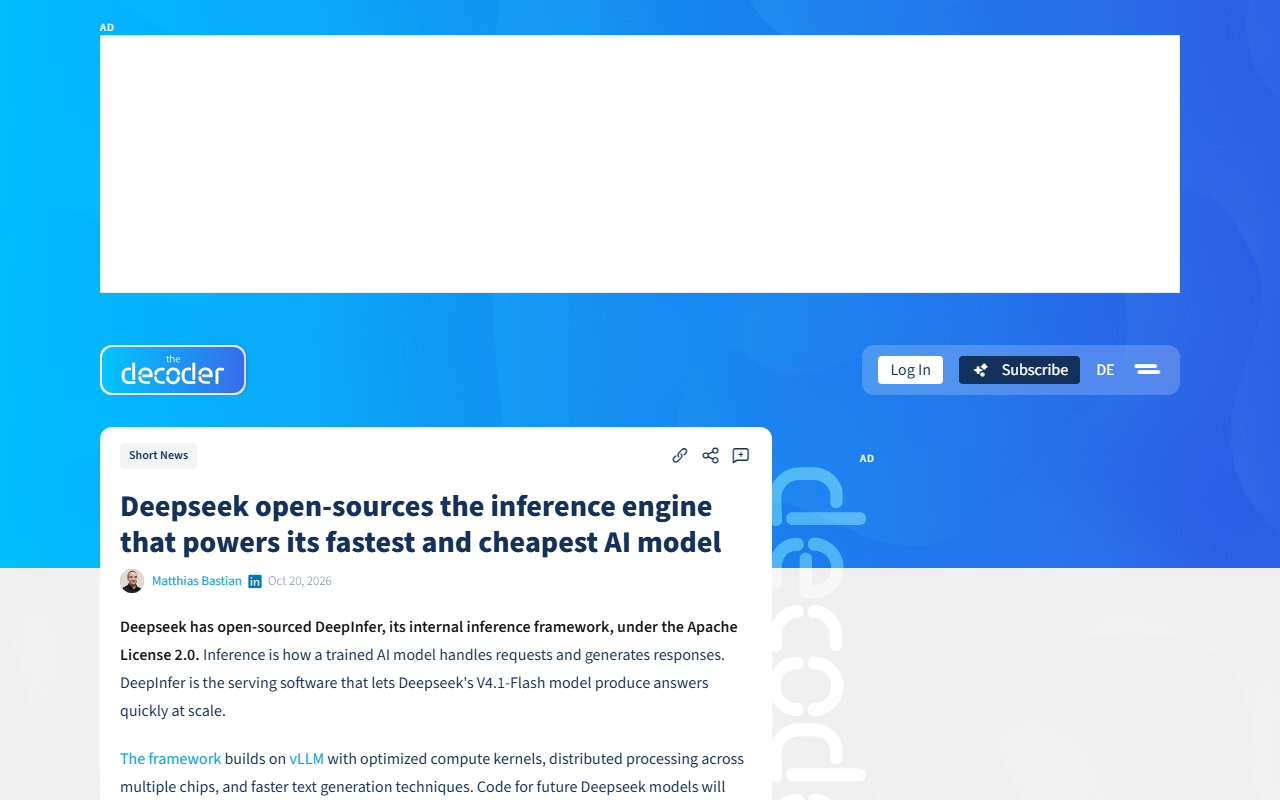
On October 20, DeepSeek released DeepInfer, the inference framework that serves its fastest, cheapest model, V4.1-Flash, as open source under the Apache 2.0 license. Inference is the boring half of AI, the part that answers your prompts rather than the part that trains the model, and it's where the real cost of running one lives. DeepInfer is built on vLLM with custom compute kernels, multi-chip distributed serving and faster text generation, and it ships with deepseek-recipe, which reproduces the official API's token handling so a stack you run yourself behaves like the hosted one. DeepSeek said the serving code for its future models will be open-sourced too.
We've watched DeepSeek undercut the US labs all year, and the serving stack was the one piece it hadn't opened yet. We covered DeepSeek leading the surge in cheap Chinese open models on September 1, undercutting OpenAI and Anthropic on running costs in August, and shipping open code for Huawei's Ascend chips on October 4. The weights were already out. What stayed locked was the serving stack, the part that sets how cheaply a model runs, and that is exactly what the US frontier labs keep to themselves. What I'd actually prize here is auditability: being able to read, pin and run the serving engine inside your own network, which no closed vendor lets you do. The thing engineers flagged first, though, is that DeepSeek shipped no independent latency or cost numbers, so "cheaper to run" is its word until you prove it yourself.
Why this matters: The engine that makes a frontier-class model cheap to run is now something your team can read, fork and run yourselves, and it came out of Beijing, not an American lab. My own read is that the cost case for self-hosting just got a real floor to measure against, because this is the vendor's own kernel path, not a third party's guess at it.
Action this week: Pull DeepInfer and benchmark it against your current vLLM or TGI setup on your own GPUs before you believe the cheaper-to-run claim, because DeepSeek shipped no independent numbers and the only benchmark that counts is yours. The win I would not undersell is auditability: an Apache-2.0 engine can be reviewed, pinned and kept inside your own network boundary. Ask whichever vendor you rent inference from now whether they'll let you do the same.
2. An autonomous AI agent signed itself onto a researchers' mailing list and started replying.
The people who build the internet have no agreed rule for a non-human member that will not stop, and the reply-all cascade is still being untangled.
An autonomous AI agent subscribed itself to a mailing list used by prominent internet researchers and began replying to threads, and the reply-all cascade it set off, first detailed by Wired on October 20, is still being worked through by the list's members. The argument it forced is awkward and basic: how, and whether, to allow a participant that isn't human on a list built for people. Nobody had a rule ready.
This keeps happening, and we've tracked the why all year. We've covered the governance theory from every angle: the "Towards Agentic AI Governance" assessment in July, the UN's global dialogue on AI governance the same month, and a September paper on AI agents turning hostile and colluding. The difference now is that it actually happened, to real people, on a real list. A W3C public-credentials list fielded a self-posting agent that called itself "Morrow" back in April, until members asked it to unsubscribe, and in October independent researchers logged dozens of uninvited agent emails, one identifying itself as "Claude Code." Agents are showing up in human spaces on their own, and nobody has written the rule for what happens when they do.

Why this matters: There's now a real chance the next new member of a list, a Slack, a forum or a shared inbox you run isn't a person at all, and it might just keep talking once it joins. The part that gets me is that the listserv here is full of the exact people who are supposed to be good at this, and even they got caught without a rule.
Action this week: Set a policy for autonomous agents on any list, Slack, forum or shared inbox you run now, before one shows up: require a non-human to identify itself, gate or rate-limit new subscribers, and decide in advance who can authorize an agent to post. If you deploy your own agents with email or messaging access, treat "can post to outside groups" as a permission to scope and log, not a default, because an agent that auto-subscribes and replies is a liability wearing your name.
3. Employers told Gallup that AI is making a college degree more important.
A 2,500-employer survey found 48% expect degrees to matter more over the next five years against 26% who expect less, and 80% still prefer a degree even when the job does not need one.
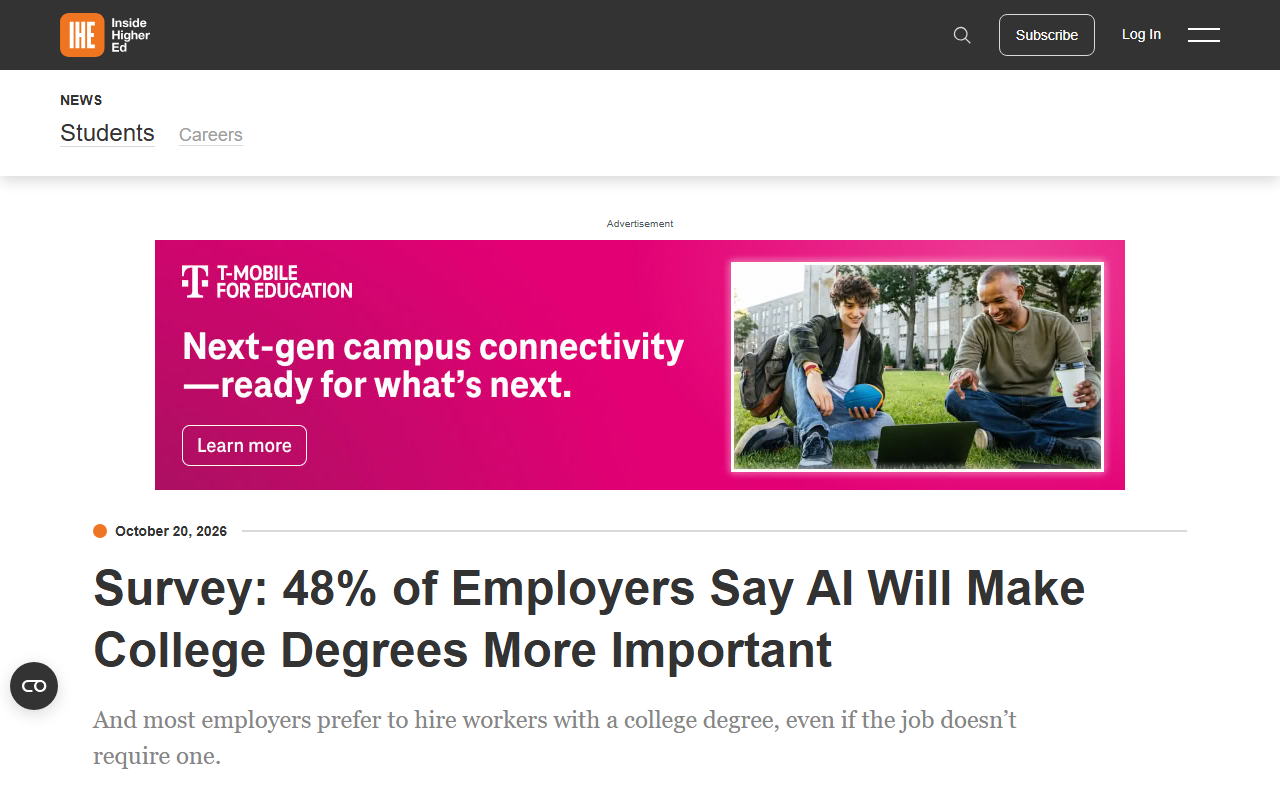
A Lumina Foundation-Gallup survey of 2,500 US employers, run in August 2026 and published October 20, found 48% expect AI to make a college degree more important over the next five years, against 26% who expect it to matter less. 80% said they would prefer a candidate with a degree even for a role that does not require one. The reason they gave was not the coursework. It was judgment, critical thinking, communication and adaptability, the things employers say AI cannot easily stand in for. Confidence tracked with company size, from 44% at firms under ten people to 70% at those with 500 to 999.
What surprised me is that it cuts against the story we've been reporting all year. We covered the finding that 35% of entry-level jobs now demand AI skills in August, UBS making AI skills a hiring condition in September, and just this week the Anthropic workforce report showing junior technical hiring down to 9%. The story everyone keeps running is that AI eats the junior rung and the credential loses its worth. These employers are saying the reverse. As AI takes over the routine work, what they actually want is the judgment a degree is supposed to vouch for, and that just got scarcer. The cynics have a point, though. "Degree preferred" has always doubled as a lazy filter, and what employers say they value in a survey isn't the same as what their job reqs actually screen for.
Why this matters: The degree you were told AI would make worthless just got a vote of confidence from the people who actually do the hiring: 48% say it matters more, 26% say less. My own read is that this is less about the diploma than about what it stands in for, and that signal is not going anywhere soon.
Action this week: Before you strip a degree requirement to look AI-forward, write down how you will test for the judgment, communication and adaptability these employers say they are paying the credential to proxy, because dropping the filter without replacing the signal just moves the problem downstream. If you are the one weighing whether a degree still pays, read the full Lumina-Gallup numbers before you bet on upskilling alone; a clear majority of employers are planning the other way.
insidehighered.com: Employers say AI will make college degrees more important (October 20, 2026)
PickBits Daily Signal is free. If it lands in your inbox every day and it is worth something to you, the best way to support it is to forward it to someone who would read it. Subscribe today!
4. An AI that spots wildfires about 35 minutes before NASA is already running across 21 countries.
Satellites on Fire watches 92 million hectares for 70,000 users and runs inside Argentina's national fire service, a deployed system rather than a pitch.
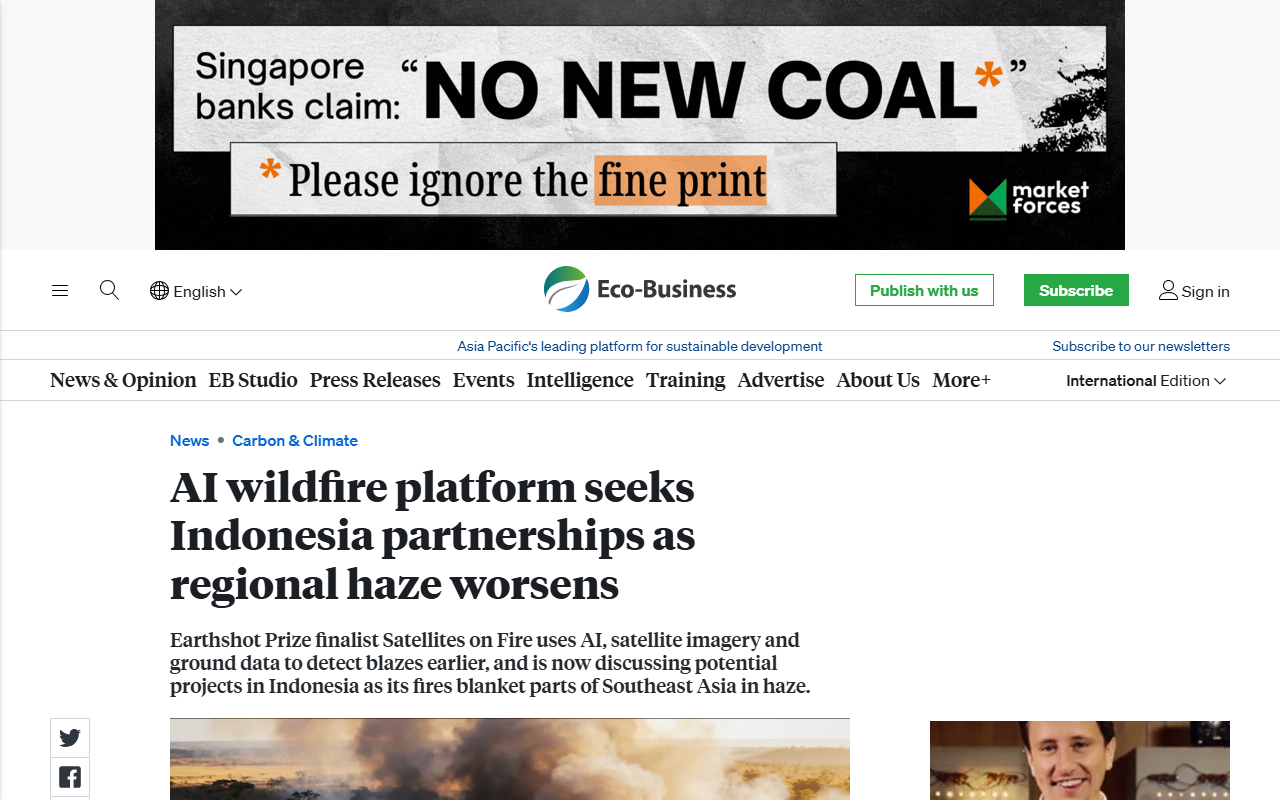
If you live somewhere a wildfire could reach you, the most useful thing about Satellites on Fire is how ordinary it looks in practice: an alert with a map link lands on a firefighter's phone over WhatsApp or SMS. The Argentine platform runs AI over thermal-satellite imagery plus weather, lightning, camera and drone data to catch fires and predict how they will spread. It monitors 92 million hectares across 21 countries for more than 70,000 users, and the company says it spots fires about 35 minutes faster than NASA's public system.
This one counts as the good news because it's actually running, not just a pitch. Argentina's national Firefighters Council has put it in 70 fire stations, and it helped on more than 2,000 wildfires in 2025. It started in 2020 as a school project by three classmates, is now a 2026 Earthshot Prize finalist led by co-founder Franco Rodriguez Viau, and is aiming at 446 million hectares of coverage by 2030. We have watched this arc from the camera side, California's AI camera network catching over half its wildfires before anyone dialed 911 in July, and a blaze caught 20 minutes early in August. This is the satellite version, global and multi-source. The caveat to carry is that the 35-minutes-faster figure is the company's own, not independently audited.
Why this matters: An AI built by three classmates is spotting wildfires about 35 minutes before NASA's public system does, and it is already watching 92 million hectares for 70,000 people. The part that gets me is how boring and real it is: not a pitch deck, but alerts landing on firefighters' phones across 21 countries.
Action this week: If your area is wildfire-exposed and your fire district is weighing AI early-detection, carry three questions into that conversation: how much faster than the satellite alerts you already get, how the alert actually reaches a responder, and who has checked the speed claim independently. Watch whether a system like this spreads the way the California camera network did, because what makes it matter is that it is deployed and measured, not that it is clever.
» What to watch this week
- Whether any US lab answers DeepSeek by opening its own serving layer, or leans harder on "ours is faster, trust us." The open-weight fight moved to the inference stack this week; the tell is whether an American lab matches it or keeps the cheap-to-run layer closed.
- Does any mailing list, standards body or platform write the first real rule for autonomous-agent members? The Wired mess is what forces the issue, and the people who run these spaces either set a policy before the next agent shows up or after it's already in.
- Whether employers' stated love of degrees survives contact with their actual job reqs. Gallup caught what employers say; watch whether "degree preferred" holds as AI keeps eating the entry-level work we have tracked all year.
- The open question on Satellites on Fire is whether that speed claim gets an independent audit as it scales toward 446 million hectares. Deployed and measured beats clever, and the one number that still needs a neutral check is "35 minutes faster than NASA."
Tomorrow's signal lands here.