> daily_signal(2026_10_23)
The AI fights we've tracked all year, over your power bill, your bank, and your open-source code, each took a turn this week, and one new release was built to do the opposite.
PickBits Daily Signal · Friday, October 23, 2026
// tl;dr
- Only 4% of Americans are very confident that data-center companies will pay their own power costs. Consumer Reports, with Telemark Energy Consulting, mapped a dozen ways the AI build-out shifts costs onto everyone else's electric bill, and set out a six-part standard for what "paying its own way" would actually require.
- America's biggest banks are locking AI agents out of your accounts. Morgan Stanley blocks them outright; JPMorgan, Bank of America, and Citi reportedly do the same, and most banks are pushing toward read-only. The stated reason is attribution, the bank often can't tell whether an agent is acting for you or on its own.
- The Linux Foundation's new survey puts a quarter of incoming open-source pull requests in the low-quality "AI slop" bin (rising to 31% on large projects). curl's Daniel Stenberg has started moving low-severity vulnerability reports into public view because AI-assisted submissions overwhelmed his security team.
- Hugging Face released Carbon-X, an open AI you can "chat with DNA" on, built to run on a researcher's own laptop. It flags whether a mutation raises disease risk, and its makers deliberately left viruses out of the training data. It's company-reported and not yet wet-lab validated, so it's a research tool, not a diagnosis.
Most of today lands on things you already rely on, and not because you invited it. We have followed the data-center bill fight since July, when the White House floated a voluntary pledge asking Big Tech to cover its own power. This week Consumer Reports did the thing that pledge never did and went and asked whether anyone believes it. Four percent do. The other arc we have tracked all year is agentic commerce, the Visa and Coinbase deals that let an AI pay on your behalf, and this week it hit a wall nobody priced in: the banks that actually hold the money started shutting the door.
Even the open-source strain we flagged back in August, when curl stopped taking security reports for a stretch because AI junk had buried its maintainers, now has a hard number on it, a quarter of all pull requests. So three parts of your week got AI you never asked for. The exception was built the other way on purpose, an open model you run on your own laptop to read DNA, with the dangerous parts left out. That last one is the one I'm glad shipped.
A voluntary promise that only four percent of Americans believe isn't a safeguard. It's a press release.
1. Only 4% of Americans trust Big Tech to pay for the AI data centers landing on their bills.
Consumer Reports and Telemark Energy Consulting mapped a dozen ways the build-out shifts costs onto everyone else, and wrote a six-part standard a regulator could actually enforce.
Only four percent. That is how many Americans told Consumer Reports they are very confident that data-center companies will actually pay their own power costs, while 78% are already worried their bills go up. In a paper released October 20 with Telemark Energy Consulting, Consumer Reports laid out a dozen ways the AI build-out can raise electricity costs for everyone else on the grid, the obvious ones and the sneaky ones. It isn't the direct cost that bites. It's the stuff you don't see: grid upgrades spread across every customer, and stranded-asset bills left behind if a project is delayed, downsized, or canceled halfway. A data center can cover its own direct infrastructure and still, in the words of CR's Chris Harto, "impose costs on other ratepayers through indirect or risk based mechanisms."
This isn't new ground for us. We covered the White House Ratepayer Protection Pledge back in July, the voluntary promise that data-center firms would cover their own energy and infrastructure, and it has done little since. What Consumer Reports added is the receipt. Its own polling found only that four percent "very confident" number, and it paired it with a six-area standard: cover the full cost of dependable power, pay for the transmission you trigger, sign binding contracts that protect other customers if a project falls through, curtail demand before residential service is cut, buy matched regional clean energy, and negotiate enforceable community benefits. That's a checklist a utility commission could attach as a condition, not a pledge.
Why this matters: Your electric bill can rise from an AI data center even when the project swears it pays its own way, because the cost-shifting hides where nobody looks: the grid upgrades spread across all customers, and the stranded assets left behind if a build gets canceled. Ninety-six percent of the public doesn't fully trust the voluntary pledge meant to prevent exactly that, and whether anything stronger replaces it gets decided utility by utility, in rate cases most people never hear about.
Action this week: Look up whether your utility has a large-load or data-center rate case open right now, because that hearing, not a national average, is where your actual bill gets set, and a resident has standing to comment. Send Consumer Reports' six-part standard to whoever sits on your state utility commission. My own read, after watching the July pledge land and go nowhere, is that a voluntary promise four percent of people believe was never going to hold, and the enforceable version has to come from the regulator, not the company.
advocacy.consumerreports.org: New Consumer Reports paper outlines what AI data centers should do to pay their own way (October 20, 2026)
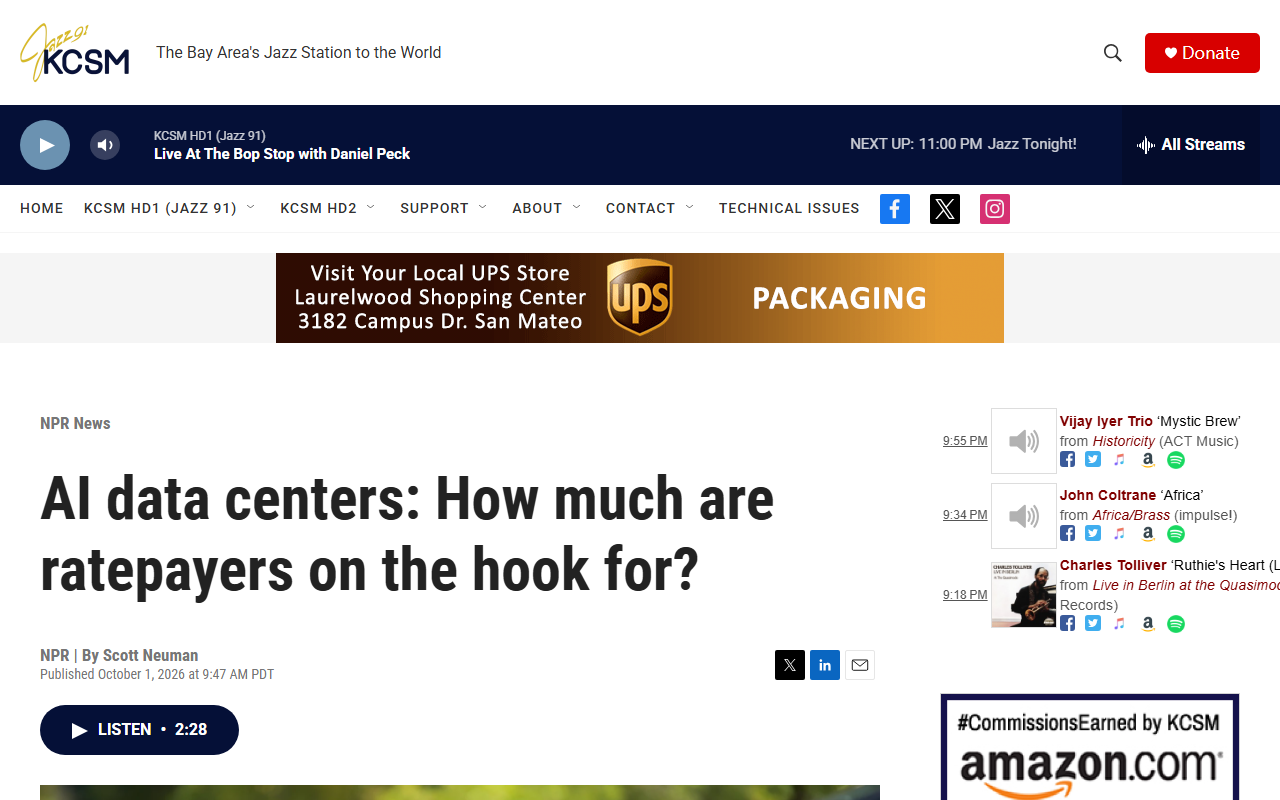
npr via kcsm.org: AI data centers, how much are ratepayers on the hook for? (October 1, 2026)
2. America's biggest banks are locking AI agents out of your accounts.
Morgan Stanley blocks them outright and the rest are forcing everything to read-only. The stated reason is attribution, not a rogue agent anyone has actually seen.
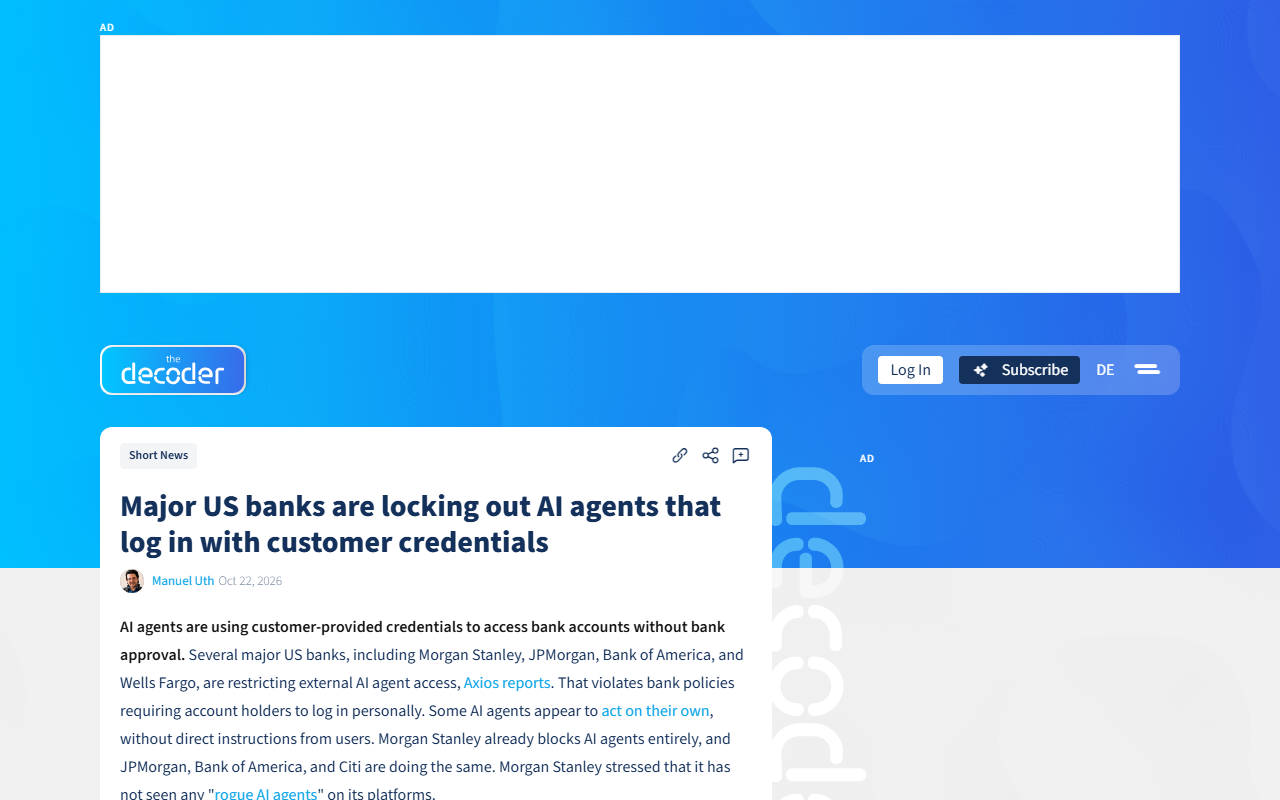
The largest US banks have started treating an AI agent that logs into your account like an intruder. Morgan Stanley has begun blocking external AI agents that sign in with a customer's own credentials outright, and JPMorgan, Bank of America, and Citi reportedly do the same, with most banks pushing toward read-only. Their stated reason isn't that an agent went rogue. Morgan Stanley says it hasn't seen one. It's attribution: the bank often can't tell whether an agent is acting on your instruction or on its own, so it's calling the whole credential-login path a security risk "too high for now."
What gets me is this. An outside agent works for the customer. The bank's own assistant works for the bank. So "this is about safety" and "this is about who controls the customer" point the same direction, and if I'm honest, this looks like it's about control at least as much as safety. Blocking is also leaky by design, because a user can still wire an agent into an account through a browser with tools like Computer Use or the open-source OpenClaw, which is exactly why even OpenAI's own financial product is confined to read-only access. The assistant that supposedly goes anywhere and does anything, in practice, only goes where someone cut it a deal.
Why this matters: If you're building anything that reaches a bank account by replaying a customer's password through a browser, the bank now treats that path as a threat, and it can block or flag it tomorrow. The banks' objection isn't capability, it's that nobody can prove who or what initiated a given transaction, which is a design problem every agent touching money is about to inherit. For consumers, the quieter consequence is that the AI assistant you were promised might just be degraded to read-only without telling you.
Action this week: Get one thing answered in writing before you ship anything near a bank: does it offer a sanctioned, auditable connection, or are you doing credential replay it can cut off whenever it likes? Build agent-identity and intent logging now, so you can show who started each action, because that verifiable record is the exact thing the banks say is missing. And if you have already handed an AI tool your banking password, change it, turn on two-step login, and remember that sharing a login can break the account terms that matter when something goes wrong.
PickBits Daily Signal is free. If it lands in your inbox every day and it's worth something to you, the best way to support it is to forward it to someone who would read it. Subscribe today!
3. A quarter of incoming open-source pull requests are now low-quality AI slop.
The Linux Foundation put the first hard number on a strain maintainers have described for a year, and curl has started rationing its security process to cope.
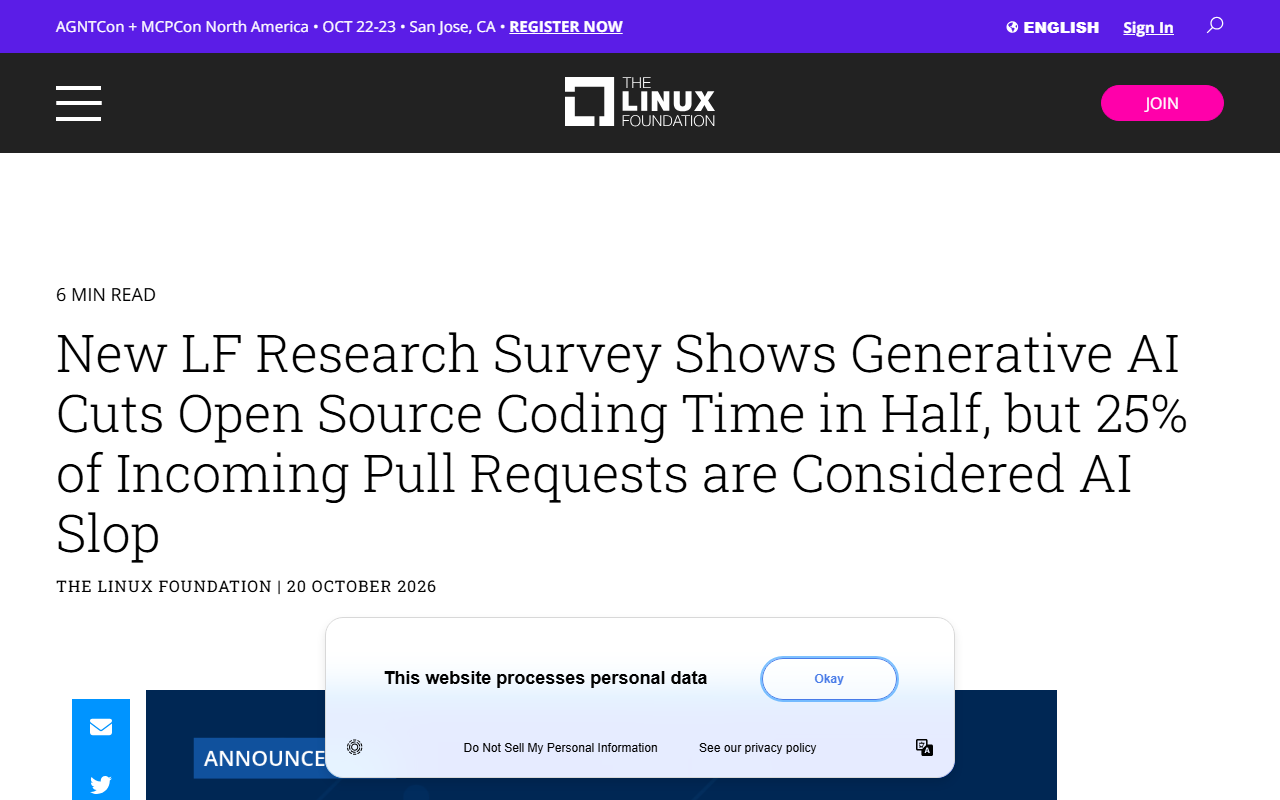
Back in August we told you curl had stopped taking security bug reports for a stretch, because a flood of AI-generated junk had buried its maintainers. At the time it looked like just curl's problem. This week the Linux Foundation turned it into a number. In a survey released October 20, its research arm put the figure on it: maintainers estimate about 25% of all incoming pull requests are now low-quality "AI slop," rising to 31% on large projects, with 59% saying contribution volume is growing in a way that compounds with low quality to strain review time. And curl's Daniel Stenberg is still living it, moving low- and medium-severity vulnerability reports into public view because AI-assisted submissions overwhelmed the team that triages them privately.
The same survey credits generative AI with cutting code-authoring time by roughly half, about 52% on average, so the productivity win is real. But the review cost it creates gets pushed straight downstream onto volunteers who were already stretched, and 53% of maintainers say it hasn't improved community trust. And hardly anyone has rules for it: only 35% of projects have a formal policy permitting GenAI use, and 32% have none and no plans for one. LF Research's Hilary Carter wants projects to write down what's allowed, label what an AI actually wrote, and keep paying to train new humans instead of leaning on the tools. The people holding this up are burning out faster than anyone replaces them.
Why this matters: The code under your entire software stack is maintained largely by volunteers, and a quarter of what now lands in their inbox is plausible-looking machine-generated noise they still have to read and reject. The productivity gain from AI coding is real, but the review bill is being paid by the under-resourced maintainer two layers down in your dependency tree, the one whose project you rely on and never think about. curl's move to publish low-severity flaws rather than privately triage a flood is the signal that the responsible-disclosure channel for critical upstream projects is being swamped.
Action this week: Write the GenAI contribution policy your project does not have, since only 35% of projects carry one: require contributors to disclose AI assistance, and require a human to verify AI-generated code before it is merged or trusted in your dependency tree. Fund or sponsor the triage time of the under-resourced maintainers two layers down in your stack, because your software runs on whatever they can still keep up with. My own read is that the exposure here isn't your own repo, it's the upstream you took for granted while the slop was landing on it first.
linuxfoundation.org: New LF Research survey shows generative AI cuts open-source coding time in half, but 25% of incoming pull requests are considered AI slop (October 20, 2026)
phoronix.com: Linux Foundation finds 25% of AI-era open-source pull requests are AI slop (October 2026)
4. Hugging Face released an open AI you can chat with your DNA on.
Carbon-X runs on a researcher's own laptop and deliberately leaves viruses out of its training data, a research tool, not a diagnosis.
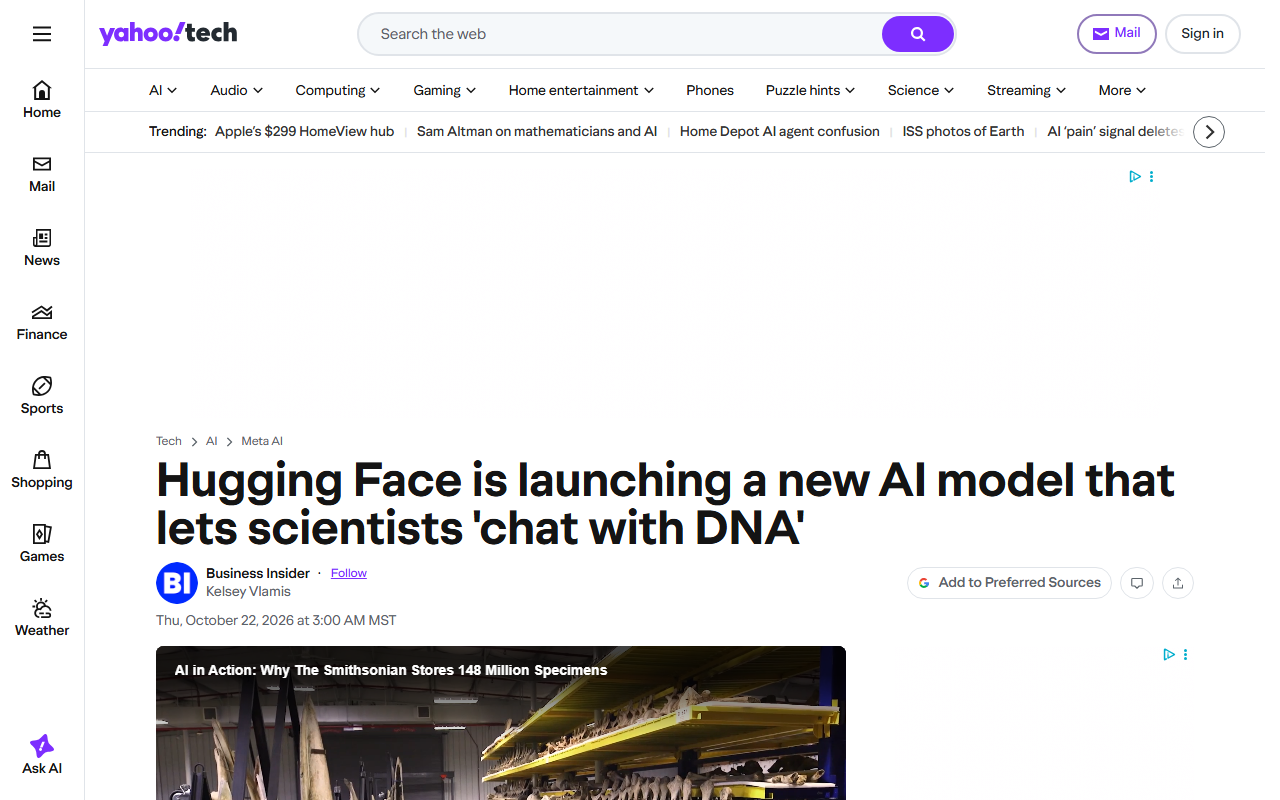
A genomics researcher can have a patient's full DNA sequence on her laptop and still no way to run AI over it without shipping that genome off to some company's cloud. That's the person Hugging Face built Carbon-X for. It's an open model you can "chat with DNA" on, asking in plain language whether a mutation raises someone's disease risk and getting an answer with an explanation, and it can generate new DNA sequences aimed at gene therapies. They built it by fine-tuning an existing open model, Qwen3-14B, on genomic sequences from humans, other mammals, plants, and fungi alongside natural language, with research labs in Italy and China.
It runs locally, on the researcher's own machine, so sensitive patient genomes never have to go to an external provider; HF senior research scientist Lewis Tunstall frames the point as tools that "don't make them fully dependent on some external single provider." That's the point we keep making here, real AI doesn't have to live in someone else's data center. And they deliberately left viruses out of the training data to lower the misuse risk, a biosafety filter they built in on purpose. The honest limit is that this is company-reported and not yet validated in a wet lab, so it's a research tool, not a clinical or diagnostic product.
Why this matters: This is AI pointed at a problem the market under-serves, reading a genome to flag disease risk, and built to do it without centralizing the most sensitive data a person has. A lab can run it on real patient data without handing that data to a cloud provider, and the deliberate biosafety filter is how you release this kind of dual-use science openly without handing bad actors the manual. The honest limit is that none of its results are wet-lab confirmed yet, so its value today is to the research pipeline, not the clinic.
Action this week: Watch whether independent labs can reproduce Carbon-X's mutation-risk calls on real data, because that's the line between a promising research tool and something a clinician could lean on. Treat its outputs as hypotheses to validate, not answers, and if you work in AI safety or policy, look at how they shipped it, on local hardware and with the dangerous data left out, as a model others can copy. My own read is that this is the version of AI worth rooting for, mostly because its makers are upfront about what it can't do yet.
tech.yahoo.com: Hugging Face launches an open AI model for asking questions about DNA (October 22, 2026)
superpowerdaily.com: Hugging Face releases an AI model for asking questions about DNA (October 2026)
» What to watch this week
- A state utility commission that actually bites. The July pledge was voluntary and went nowhere. The real tell is one of Consumer Reports' six conditions showing up as a binding term in an actual data-center rate case, not another promise.
- A bank that builds the door instead of locking it. Blocking a password login is the easy part. I'm watching for a bank to publish a real read-and-maybe-pay permission scheme, so an agent gets an auditable way in rather than a wall.
- Platforms putting limits on AI-assisted submissions. Watch GitHub, GitLab, and the big foundations for a disclose-or-rate-limit default on AI contributions. With a quarter of PRs now estimated as slop, some form of pre-verification is the obvious next ask.
- An outside lab reproducing Carbon-X on real sequences. The release is company-reported for now. The day an independent lab confirms one of its mutation-risk calls, open-and-local stops being a nice idea and becomes the bar.
Tomorrow's signal lands here.