> daily_signal(2026_10_24)
This week AI showed up in four parts of an ordinary day: your car on the road, your back office, your design tools, and the open-source code the whole internet runs on.
PickBits Daily Signal · Saturday, October 24, 2026
// tl;dr
- The EFF turned the license-plate surveillance fight into a drafting checklist for your state legislature. Six states passed ALPR limits in 2026; the framework runs from a full statewide ban down to near-immediate deletion of non-matching reads, a warrant to search stored data, and an outright ban on the AI analytics layer: vehicle fingerprints, face recognition, and predictive-policing hotspot maps.
- Anthropic launched Claude Duet, an always-on agent that chases invoices and preps payroll from its own cloud machine, built on Opus 5.5. It can read, draft, and prepare on its own, but has to ask before it sends, pays, signs, or deletes; moving money between accounts and trading securities are blocked even with approval, and bank transfers are blocked outright.
- Canva released Craft, its first in-house image model, and says it trained mostly on its own design templates rather than scraped photographs. Craft renders text in 55 languages, splits outputs into editable Magic Layers, and is live for everyone through Dream Lab and the public API, though its leaderboard ranking and training-data claim are Canva's own.
- Anthropic and a partner called Theorem used Claude to generate formal proofs of correctness for 123 open-source libraries, catching a bug hidden in the open for over a decade. About 180 million lines of proof in a few weeks, each checked by the Rocq engine, though the proofs hold only for one chip architecture, single-threaded code, and inputs under 64 MB.
The one that actually moves something this week is the license-plate fight. We've been on it since the 404 Media investigation on October 1 showed how a 1980s drug program quietly funnels every plate scan into a federal database, and then watched one town after another start pulling the cameras down. This week the Electronic Frontier Foundation stopped describing the problem and handed state legislators the exact text to end it, which turns a year of outrage into something a lawmaker can actually file.
The other three are quieter, and they each land somewhere different. Anthropic shipped the first always-on work agent built to touch your money and spent most of its announcement on the wall it has to stop at. Canva built its own image model and made a point of how it was trained, not just what it can do. And the one to end on: Anthropic and a startup used Claude to mathematically prove a stack of open-source code correct, which is the rare AI story this week that is just plain good news for the code the rest of it runs on.
A year of license-plate outrage became a bill a lawmaker can file, the same week an agent learned to chase your invoices and Canva bet its new image model on what it wouldn't scrape.
1. The EFF turned the license-plate fight into a bill your state can actually pass.
Six states acted in 2026; the framework runs from a full statewide ban down to a ban on the AI analytics that turn a camera into a tracking network.
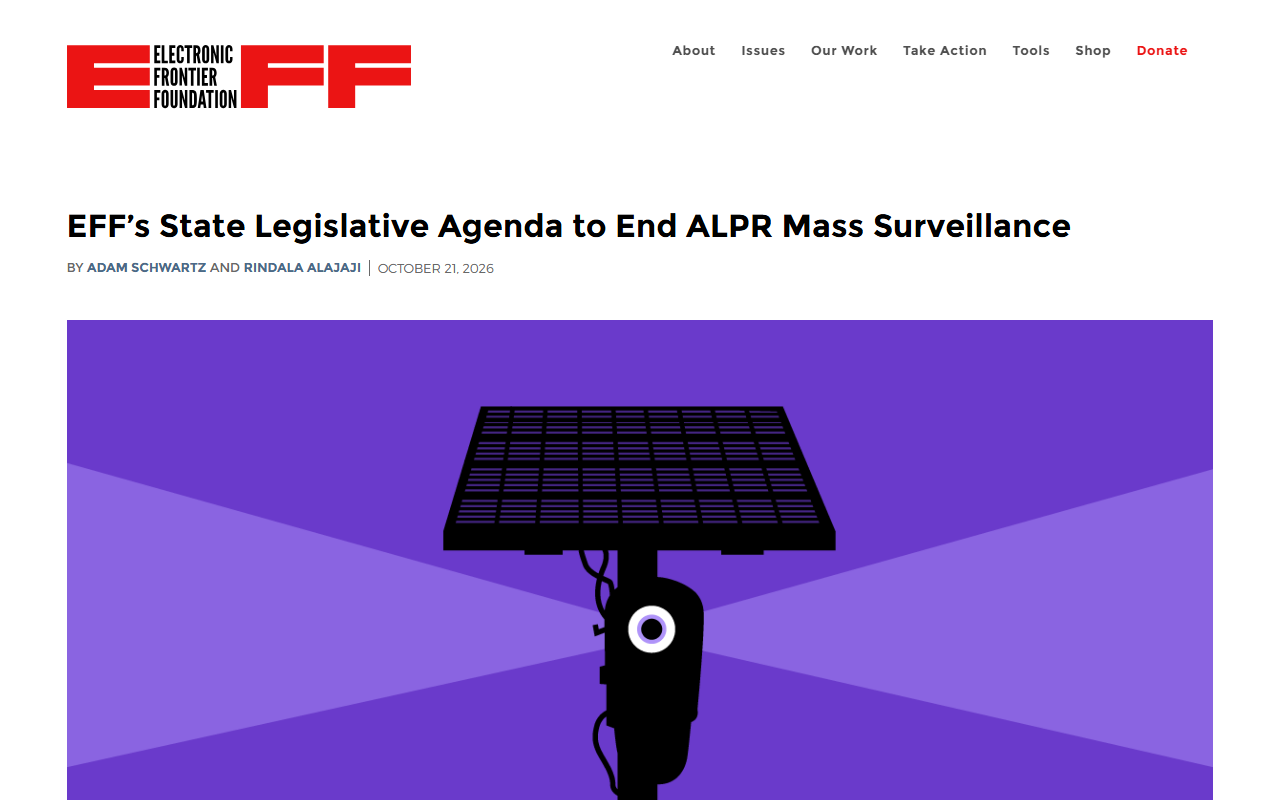
The Electronic Frontier Foundation published a state-legislative framework on October 21, written by Adam Schwartz and Rindala Alajaji, for ending automated license-plate-reader mass surveillance. It reads like a settlement ladder. Best case, a full statewide ban on police ALPR mass surveillance, with the cameras decommissioned and the funding cut off. Short of that, real-time-only use, near-immediate deletion of any read that doesn't match a hotlist, and a warrant required to add a plate to that list. Short of even that, retention measured in days rather than months, a warrant to search stored data, 30 days of public notice before a town can buy the system, a statewide registry, regular audits, and a private right of action so an ordinary driver can sue. New Hampshire has required deletion of non-matching reads within three minutes since 2007, so the strict end of this already exists in law today.
The part doing the real work is the top layer. The framework asks lawmakers to ban the AI analytics outright: the vehicle fingerprints, the face recognition, the predictive-policing hotspot maps, and the resale of the data. That is the line between a camera and a tracking network, and it is where false AI plate-reads have already gotten innocent drivers detained. The 2026 record it responds to is real. Six states, Connecticut, Kentucky, New Jersey, New Mexico, Oregon, and Washington, enacted limits this year; Texas barred state funds for Flock cameras; and Florida ordered them off highway rights-of-way. All of it against one number worth repeating: more than 99% of the drivers an ALPR scans are on no hotlist at all.
Why this matters: There is a decent chance a camera on your street already logs every time you drive past, and more than 99 times out of 100 you were never on any list. This isn't new ground for us; we walked through the federal-database side of it on October 1, and the honest read then was that exposing the problem was the easy part and getting a state to unwind it was the wall. This framework is the first thing I've seen that gives a lawmaker the actual text instead of a grievance.
Action this week: Find out whether your town runs Flock, Motorola, or Axon cameras, how long they keep the reads, and whether the analytics, the vehicle fingerprints and hotspot maps, are switched on. That last switch is the one that matters most. My own read is that the retention clock is where a resident has the most standing, because "delete it within three minutes" is concrete enough to hold an agency to in a way "use it responsibly" never is. And if your statehouse is drafting anything this session, the EFF framework is the floor to point your representative at.
eff.org: EFF's state legislative agenda to end ALPR mass surveillance (October 21, 2026)
2. Anthropic's Claude Duet is an always-on work agent built to touch your money.
It reads, drafts, and preps payroll on its own, but has to ask before it sends, pays, or signs, and bank transfers are blocked outright.
Claude Duet, announced October 22 as a research preview, is an always-on agent built on Claude Opus 5.5 that runs on its own cloud virtual machine with a browser, so your own devices don't have to stay on. It connects through Anthropic's marketplace to Gmail, Slack, Stripe, Docusign, and Shopify, sends a short morning summary, and then only pings you when something needs attention. What it is for is unglamorous and specific: chasing unpaid invoices, drafting payment reminders, prepping payroll. It is aimed at professionals and small-business owners, open by waitlist to US Pro and Max subscribers, and is described as weaker at personal errands.
The substance is the permission model, and it is unusually legible. On its own the agent can only read, draft, and prepare. It has to get explicit approval before it sends a message, makes a payment, signs a document, or deletes anything. Trading securities and moving money between accounts are blocked even with approval, and bank transfers are blocked entirely. It never sees your passwords, purchases run through a virtual card so your real number isn't shared, and a classifier screens for sensitive health and financial data. The honest caveats are in the announcement too: to conserve usage it checks accounts only every few hours, and Anthropic concedes the early version can misread a thread, misjudge urgency, and miss anything that lands between checks. It joins a crowded autumn, after SpaceXAI's Grok Bot in August and Meta's Muse and OpenAI's Dots in September.
Why this matters: The first time you hand an agent your inbox and your Stripe account, you aren't buying a feature, you're deciding how much of your business can move without you in the loop, and Duet's answer is an unusually careful one. My own read is that the permission wall is the actual product here. Anyone can demo an agent that chases an invoice; the hard part is the list of things it isn't allowed to do alone, and that list, no sends, no payments, no transfers without a yes, is what I'd evaluate first.
Action this week: Get one thing answered in writing before you connect it to anything that touches money: what can it do without asking, and what is the exact list it must ask permission for. Then scope its Gmail and Stripe access to the least it needs and keep it in read-and-draft mode until you've watched it work for a week. When I've let software near accounts-receivable before, the trouble always came from the small actions it handled quietly on its own, while the big ones were the ones it stopped to ask about.
3. Canva built its own image model and says it never trained on a scraped photograph.
Craft renders text in 55 languages, splits outputs into editable layers, and is live for everyone, though the ranking and the training claim are Canva's own.
Canva released Craft on October 23, its first in-house image-generation model, trained from scratch by Canva Research. The capabilities are genuinely strong for a design tool. Craft plans composition, proportions, and text before it generates, outputs up to 2K across more than 30 aspect ratios, and renders readable text in 55 languages. A Magic Layers feature splits a result into editable layers, so you get a file you can keep working rather than a flat picture, and the whole thing is built on the Leonardo.ai team Canva acquired in 2024. It is live for every user through Dream Lab and Canva's public API, with cheaper Craft-fast and Craft-ultrafast tiers and ChatGPT and Gemini integration on the way.
But the newsworthy choice isn't the feature sheet, it is the training data. Canva says Craft was trained mainly on its own millions of design templates rather than scraped photographs, a deliberate swerve away from the norm that's currently being fought over in court. Keep it honest, though. The claim that Craft ranked fourth overall and first for portraits on the DesignArena leaderboard, and the training-data description itself, are both Canva's own, and neither has been independently audited.
Why this matters: If you make anything in Canva, the generator inside it quietly became a different thing today, and the interesting part isn't that it makes prettier images, it is what it claims it learned from. We've tracked the training-data fight all autumn, from the car-photography studios suing Midjourney to the Third Circuit ruling in October that training on copyrighted work isn't automatically fair use. Against that backdrop, "we trained on our own templates, not your photos" is a real position rather than marketing, if it holds up.
Action this week: Try it on an actual brief, not the demo prompt, because the only ranking that matters is how it does on your work. Hold off on making it your default until you've compared it head to head with whatever you pay for now. And if you sell what you make, treat the template-trained claim as the question to put to every image vendor you use, because provenance is quietly becoming a commercial-rights problem and Canva just made it a checkable one.
the-decoder.com: Canva launches Craft, its first in-house image model (October 23, 2026)
theverge.com: Canva built its own AI image model (October 2026)
PickBits Daily Signal is free. If it lands in your inbox every day and it is worth something to you, the best way to support it is to forward it to someone who would read it. Subscribe today!
4. Anthropic used Claude to mathematically prove 123 open-source libraries correct.
About 180 million lines of proof in a few weeks, each checked by the Rocq engine, and it caught a logic bug hidden in the open for over a decade.
Anthropic, with a partner called Theorem, used Claude to generate formal proofs of correctness for 123 open-source libraries drawn from Google's OSS-Fuzz project, roughly 180 million lines of proof code in a few weeks, each one verified automatically by the Rocq proof checker. Formal verification is the gold standard for proving software can't fail, and it has always been too expensive to use: formally verifying the seL4 microkernel once took about 20 person-years, which is why almost no real-world code ever gets it. Claude translated crash tests into mathematical problems and read the compiled machine code to build the proofs, and Claude Opus 5.5 solved half of them using roughly 40% fewer tokens than the previous model.
The results are the point. Claude found hundreds of bugs that conventional testing had missed and was allowed to fix them; in one PDF reader it surfaced as many security bugs in a week as the project usually sees reported in a year; and it caught a logic error that had been sitting in the open for more than a decade. This is a different thing from the free bug-scanner Anthropic handed open source earlier this month. That one hunts for likely bugs; this one proves there are none, within its envelope. And the envelope is the honest caveat: the proofs hold only for a single processor architecture, single-threaded programs, and inputs under 64 MB, and each one burns hundreds of millions of tokens.
Why this matters: Almost every app you opened today runs on open-source code that volunteers maintain and that almost no one has ever proven correct, because doing it has always been far too expensive to be worth it. That is the part that just changed. After a week of stories about agents misreading threads and getting into trouble, this is the one I'd actually forward: not AI guessing at bugs, but AI doing the twenty-person-year math that almost no project could ever afford before. Theorem, the startup in the byline, is the name to remember here.
Action this week: Watch Theorem's roadmap, because the next targets are glibc, OpenSSL, and cURL, the libraries the entire internet quietly runs through, and proving those correct would matter far more than 123 smaller ones. Read the scope limits honestly when you see this cited, because "proved safe" isn't what happened; "proved safe for one chip, single-threaded, under 64 MB" is. My own read is that the cost curve is the real story here, not the 123: if formal proof keeps getting cheaper, it stops being a museum piece and starts being something a maintainer can run.
» What to watch this week
- Whether any state picks up the EFF framework verbatim in its next session. The six 2026 laws were a patchwork; the tell is whether a legislature adopts the analytics ban, vehicle fingerprints and predictive policing, and not just the retention limits, because that's the clause the vendors will fight hardest.
- Whether Duet's approval wall survives contact with real small businesses. The interesting failure mode isn't a rogue payment, those are blocked; it is whether "checks every few hours" and "can miss what lands between checks" turns out to be too slow for the invoice-chasing it was built to do.
- Whether anyone independently verifies Canva's training-data claim. The DesignArena ranking and the "templates, not photographs" description are both Canva's own; the move that would make this a landmark rather than a press release is an outside audit, or a rival matching the claim out loud.
- Whether Theorem reaches glibc, OpenSSL, and cURL, and whether the proofs get cheaper. Proving 123 mid-size libraries is a demo; proving the three libraries the whole internet depends on, at a cost a volunteer maintainer could bear, is the thing that would actually change software's floor.
Tomorrow's signal lands here.