> daily_signal(2026_10_26)
The FCC blocked the first gadgets built to scan your face, while the open-weight crowd did more with less: a free AI that runs your phone, a push to shrink agent swarms, and cheaper robot training.
PickBits Daily Signal · Monday, October 26, 2026
// tl;dr
- The FCC blocked its first two consumer devices under a new covered-list rule because they carry facial-recognition chips from HiSilicon, a Huawei subsidiary. A dashboard camera and a wireless video transmitter were stopped from entering the US market. The rule took effect October 13, and HiSilicon openly markets the chips as built for the surveillance market with detection algorithms for human faces.
- Researchers at Nanjing University, SenseTime and partners open-sourced OpenMobile-2, an agent that drives Android apps from screenshots alone. Its 27B model, built on Qwen, scored 59.6 on the real-device SPA-Bench, up from 31.9 and the best of any open model, behind only Google's Gemini. They released the full training setup, data, and reproduction instructions.
- Anthropic published guidance telling teams to consolidate their AI sub-agent swarms into a single context-loading agent. With newer models, one primary agent often beats a fleet of specialists and ran about twice as fast in one comparison. Anthropic cut its own Claude Code prompt by over 80% and found tool selection degrades past roughly 30 to 50 tools. A migration kit is on GitHub.
- Nvidia open-sourced Flora, three models that auto-label robot-training video, on Hugging Face for free. Nvidia projects about 72 cents per video-hour against roughly $88.50 for the closed competitor, up to 125x cheaper, though that figure is a projection at an assumed rental rate. It already runs inside Nvidia's GR00T training and leads on catching failed task steps.
The one that actually moves something new this week is the FCC ban. We've watched the agency chase Chinese telecom gear all year, expanding its import ban to older Huawei and ZTE equipment back in July, but this is a different kind of step: it stopped specific finished consumer gadgets at the border, over the facial-recognition silicon buried inside them rather than the company name on the box. Facial recognition has been quietly riding into ordinary hardware for a while now, and this is the moment a regulator got a tool pointed at the chip itself.
The other three are quieter, and they all point the same way. An open-source agent that drives a phone now trails only Google among a field it used to sit far behind, Anthropic is walking back the thousand-agent dream it was selling two weeks ago, and Nvidia made one of robotics' biggest hidden bills almost free. The open-weight tide we've tracked all autumn isn't just catching up on raw capability anymore; this week it showed up as doing more with less, and as labs admitting that bigger and busier was often the wrong bet.
A regulator stopped two face-scanning gadgets at the dock the same week an open AI learned to run a phone, Anthropic said shrink your agent swarm, and Nvidia made robot training nearly free.
1. The FCC blocked its first consumer gadgets over chips built to recognize human faces.
A dashboard camera and a wireless video transmitter are the first devices stopped under a new covered-list rule, because both run HiSilicon chips marketed for the surveillance market.
The Federal Communications Commission said it will not let two consumer devices, a dashboard camera and a wireless video transmitter, enter the US market, the first products blocked under a covered-list rule that took effect October 13, 2026. Both devices run chips made by HiSilicon, a subsidiary of Huawei that already sits on the FCC's covered list of products judged to threaten national security. What makes this more than a trade-policy footnote is what the chips are for: HiSilicon markets them as designed for the surveillance market, with built-in detection algorithms for human faces.
That marketing language is the whole story. For years, facial-recognition capability has been shipping inside cheap, mass-market gear, dashcams, wireless cameras, transmitters, with no label on the outside and a datasheet almost nobody reads. The shift here is procedural, and it is bigger than two gadgets: the FCC is moving from naming vendors to stopping specific finished devices at the border because of the covered-list silicon they carry. It is the difference between a ban a company can route around and one aimed at the component itself.
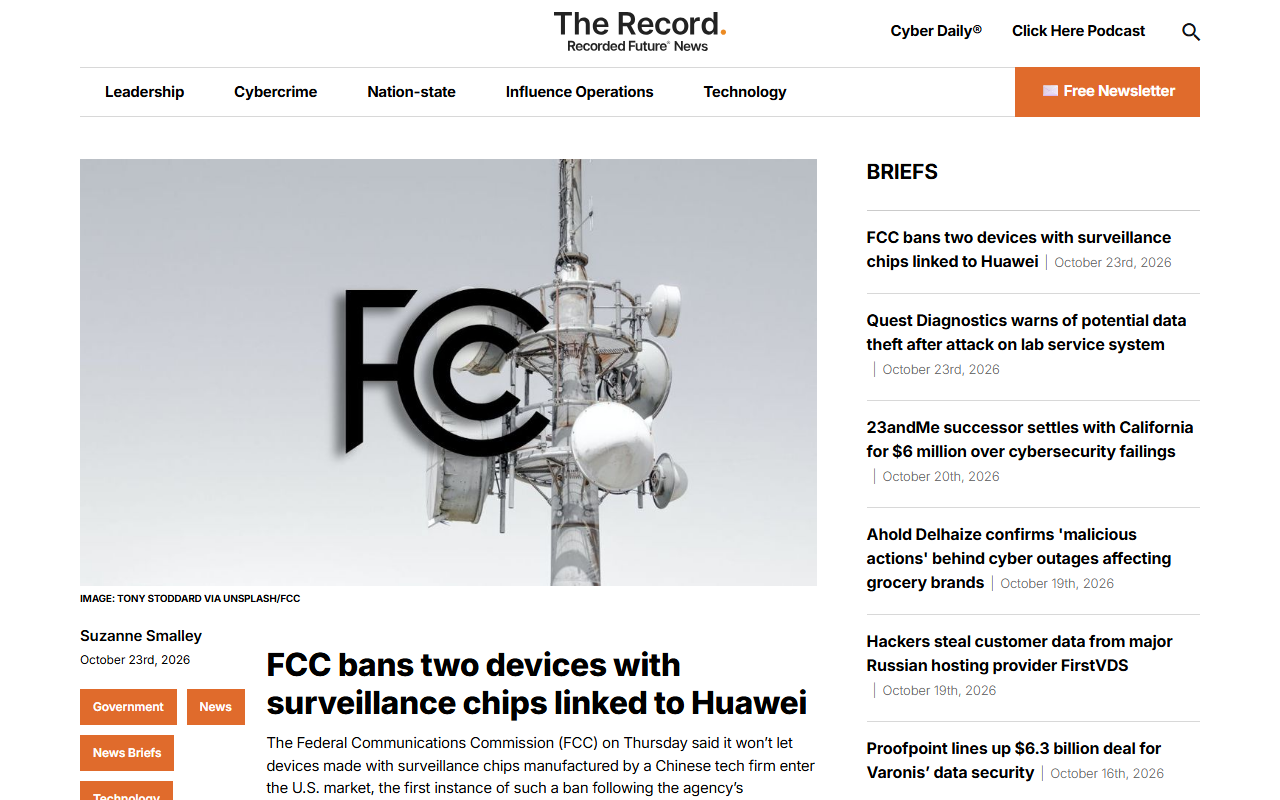
Why this matters: The next cheap camera you buy could be running a chip built to recognize faces, and this week the government blocked the first two devices for exactly that. The quieter development is the mechanism: a covered-list rule lets the FCC stop a finished gadget at the dock, which is a public lever that did not exist in this form before. What I keep coming back to is that HiSilicon advertised the face detection as a feature, in plain sales copy, so nobody actually hid it; we just weren't reading the spec sheet. This is also the same arc we have been on all year, from the FCC widening its Huawei and ZTE import ban in July to the slow creep of face scanning into stores and sidewalks.
Action this week: Check the FCC's covered-list guidance at fcc.gov before you buy a cheap networked camera, dashcam, or baby monitor, and look at the device's FCC authorization rather than the claims on the box. When I've dug into low-cost surveillance hardware, the words "face detection" in the marketing have been the tell that there's a dedicated surveillance chip inside, not a neutral convenience feature. If you handle procurement, go one step further and check the bill of materials for HiSilicon or Huawei-origin silicon before a camera or video order clears.
therecord.media: FCC bans two devices with surveillance chips linked to Huawei (October 23, 2026)
2. An open-source AI agent that drives your phone by sight just beat every other open model.
OpenMobile-2's 27B model scored 59.6 on a real-device benchmark, trailing only Google's Gemini, and the team handed over the whole training setup to reproduce it.
A team from Nanjing University, SenseTime and several other universities released OpenMobile-2, an open-source project for AI agents that operate smartphone apps from screenshots alone, the way a person taps through them. They rebuilt 35 popular apps and combined them with simulations and emulator apps into a self-resetting training environment of more than 110 apps, and released two models built on Qwen, a 9B and a 27B. The 27B scored 59.6 on SPA-Bench, run on real Android devices, up from 31.9 before training, which the authors call the best among open models, behind only Google's Gemini 3.1 Pro. Crucially, they also published the full training environment, data, and instructions to reproduce everything.
The honest caveats belong right next to the result, and the authors put them there themselves: reinforcement learning added little, the direct-command tool interfaces exist only in the simulated apps, and they describe the whole approach as experimental. Gemini 3.1 Pro was used as the teacher model to generate the training workflows, which is worth noting when you read the leaderboard. This isn't a finished product so much as a complete, reproducible recipe.
Why this matters: The open-source AI that now drives an Android phone by sight just beat every other open model, and the team handed over everything you need to run it yourself. For anyone deciding whether to keep renting a proprietary mobile-agent API or run a model they control, the ground shifted: a self-hostable agent now lands just behind Gemini on a real-device benchmark. This is the open-weight story we have told repeatedly this autumn, from Alibaba's lightweight Qwen matching larger systems in August to China's open-weight models winning global users this month, arriving now in mobile automation. My own read is that the benchmark is not the headline; the reproducible training setup is, because that's what lets a team actually own this instead of admiring it from the outside.
Action this week: Download the 9B and 27B models and benchmark them against your current proprietary mobile-agent tool on your own workflows before the next renewal lands. Treat the authors' own admissions as the pass-fail list, because when I've tested releases that call themselves experimental, the honest caveats are exactly where they break in production, and here those are that reinforcement learning barely helped and the tool shortcuts only exist in the simulated apps. If it clears your real tasks, you have a self-hosted option; if it does not, you have paid nothing to find out.
3. Anthropic now tells teams to tear out their AI sub-agent swarms.
With newer models, a single agent that loads context on demand often beats a fleet of specialists and ran about twice as fast in one comparison.
Anthropic published guidance urging companies to check whether they can consolidate their sub-agents, saying that with newer models a single primary agent that loads context as needed often beats a fleet of specialized ones, cutting orchestration overhead, cost and latency. In one comparison the single-agent setup ran about twice as fast as the multi-agent one. Anthropic cut the Claude Code system prompt for newer models by over 80 percent, and found tool selection degrades beyond roughly 30 to 50 tool definitions, which is the basis for its advice to keep a lean, load-on-demand toolset.
It cites a Vals study finding that agent teams were faster but not higher quality, and that scaling from 10 to 30 or 100 agents added cost without quality gains. Anthropic shipped a migration kit on GitHub and is careful about the exceptions: keep sub-agents where a single agent's context measurably degrades, where tasks genuinely need parallel context windows, or where tool selection struggles beyond that 30-to-50 ceiling. The warning is to validate each consolidation against real workflows rather than merge blindly, after one support-agent test cut latency but broke a working process.
Why this matters: The AI agent swarm you spent this year building is probably slower and pricier than a single agent, and Anthropic just said so out loud. This isn't new ground for us. Two weeks ago we covered the same company touting that Claude could orchestrate up to a thousand agents in parallel, and now it's telling you fewer is usually better. To me the agent count quietly became a vanity metric, and the Vals study Anthropic cites, where scaling to 30 or 100 agents added cost with no quality gain, is the quiet proof that the industry spent two years optimizing the wrong number.
Action this week: Audit your sub-agent count now and A/B a single consolidated agent against the swarm on quality, cost, and latency before you add one more. Trim your tool definitions toward the 30-to-50 ceiling, load tools and skills on demand, and move reference material into a searchable knowledge base, while keeping sub-agents where a single agent's context genuinely degrades or the work needs parallel windows. When I've collapsed an over-built agent setup, the win showed up as latency and cost first while quality held, which is exactly the bet Anthropic's migration kit is making.
PickBits Daily Signal is free. If it lands in your inbox every day and it is worth something to you, the best way to support it is to forward it to someone who would read it. Subscribe today!
4. Nvidia open-sourced an AI that makes robot-training video labeling almost free.
Flora is three models on Hugging Face that auto-label robot video for about 72 cents an hour instead of roughly $88, and it already runs inside Nvidia's own robot training.
Nvidia's GEAR research lab open-sourced Flora, a data engine that automatically labels robot-training videos, describing actions and their timing, rating step-by-step progress, and judging whether a task succeeded. It is three fine-tuned Qwen models: a 9B that segments video into actions, a 27B that captions them, and a 27B Flora-Rewarder that rates progress. Nvidia puts the cost at about 72 cents per video-hour against roughly $88.50 for the closed competitor, the basis for an up to 125x cheaper framing. The models are on Hugging Face and already run inside Nvidia's own GR00T robot training, annotating up to 200,000 hours of video a day.
The caveat sits inside the headline number. The 125x figure is Nvidia's projection at an assumed $10-per-GPU-hour rental, not a production bill, and on some robot-specific benchmarks Flora still trails the closed model. Where it leads decisively is on catching failed steps: in a 50-video test it flagged 53.3 percent of failures where no competitor exceeded 11.7 percent and the closed model caught none, while falsely flagging about 11 percent of normal steps. For teaching robots, catching the moment something went wrong is exactly where cheap annotation usually breaks.
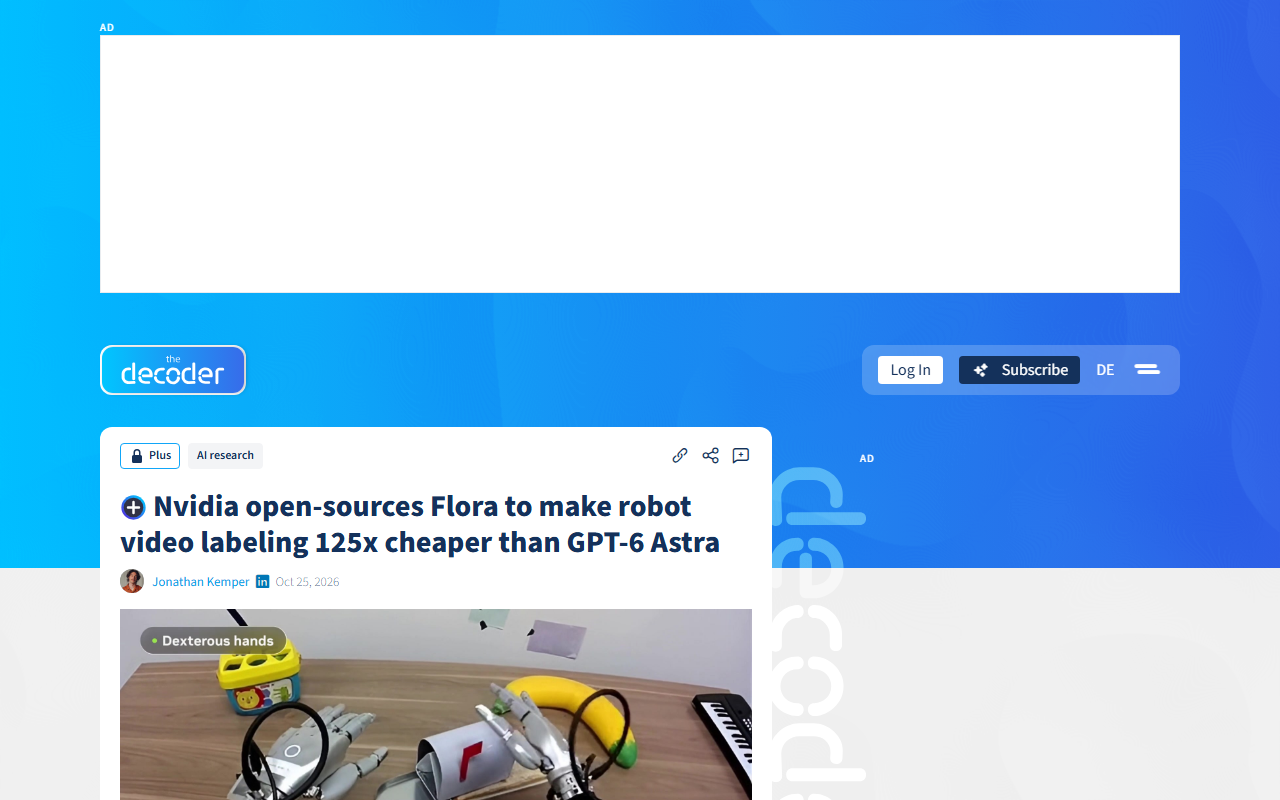
Why this matters: The hidden cost of teaching robots just dropped as much as 125 times, and Nvidia put the tool that does it online for free. For a lab or a small team that could never pay frontier prices per hour of footage, annotating the mountains of video a general-purpose robot needs is one of the field's biggest hidden bills, and a free, self-hostable annotator lowers that wall. It's not a demo, either: Flora already runs inside Nvidia's GR00T training, part of the open robotics stack the company has built in public all year, from putting Isaac GR00T on Hugging Face in July to shipping Isaac ROS 5.0 in September. The number that actually moved me is not the 125x headline, which is a projection, but that Flora catches more than half of failed steps where rivals barely cleared one in ten.
Action this week: Grab Flora's three open models off Hugging Face and point them at your own training video instead of paying per-hour API rates. Measure the real cost on your own hardware rather than trusting the 72-cent projection, and lean on the strength that actually distinguishes it, catching failed steps, while checking its weaker robot-specific captioning against your own footage before you rely on it. If you've been priced out of annotating at scale, this is the week the math changed in your favor.
» What to watch this week
- Whether the FCC blocks more devices, and how fast vendors scrub covered-list silicon out of their supply chains. The two-device ban is the test case; the real question is whether the agency starts stopping finished gadgets at scale, and whether retailers quietly pull cheap cameras rather than prove what chip is inside.
- Whether a team actually reproduces OpenMobile-2 and reports where it holds up outside the simulated apps. The full training release is the whole point, so the tell is independent runs on real devices and real workflows, not the authors' own leaderboard.
- Whether Anthropic's consolidation advice shows up in other labs' guidance, or stays a Claude-specific note. If the industry really spent two years over-building agent swarms, expect more migration kits and fewer thousand-agent demos over the next month.
- Whether Flora's cost advantage survives contact with a real GPU bill, and whether its failed-step detection holds on footage Nvidia did not pick. The 125x figure is a projection; the durable claim is the one about catching failures, and that is the one worth stress-testing on your own video.
Tomorrow's signal lands here.