> daily_signal(2026_11_03)
OpenAI wants to write frontier-AI rules through the statehouses, a startup is selling forecasts of how 30 million people will act, and Goldman Sachs pulled its AI coders from all but its engineers.
PickBits Daily Signal · Tuesday, November 3, 2026
// tl;dr
- OpenAI is building a post-midterm operation to write the rules for frontier AI, and routing it through big-state legislatures instead of a deadlocked Congress. Policy chief Chris Lehane is pushing binding "speed limit" safety rules for the most powerful models and calls fast-tracking them his top priority. The real play is "reverse federalism": get large states to mirror each other's AI laws into a de facto national standard. OpenAI's federal lobbying spend rose from roughly $1.8 million to nearly $3 million in 2025.
- A startup called 42AI came out of stealth selling predictions of how individual people will behave, already running at about 10 brokerages. Its "behavioral world model" is trained on data covering nearly 30 million people, plus government and biobank data on more than 2 million. The company says it "never knows who the person is," yet still builds individual profiles from linked activity. Co-founder Ehud Ezra conceded a firm using those forecasts against its own customers is "a valid concern."
- Goldman Sachs cut most employees off from advanced AI coding tools, including Claude Code and GitHub Copilot, leaving them to engineers only. A spokesperson said the "experimentation phase" is over and the tools now go to those "best suited to leverage them," citing productivity and risk management. The October decision reverses CIO Marco Argenti's July pitch for non-technical "vibe coding."
- A one-person biotech used Claude to push a rare-disease drug from idea to promising animal results in under 18 months, and Anthropic just bought it. Founder Cody Tranbarger ran experiments across 11 external labs to advance an antibody for two rare forms of muscular dystrophy. The work is still preclinical and mice-only; Anthropic projects possible human trials as soon as late 2028.
For months we watched OpenAI ask Washington for rules it could live with: a "Frontier Governance Framework" in May, a "blueprint for democratic governance of frontier AI" in June, an endorsement of Illinois' audit bill along the way. With Congress stalled, OpenAI is now building a machine to write those rules in the statehouses instead, and its policy chief has made fast-tracking them his first priority. Fifty matching state laws are harder to fight than one federal bill, and that's the point.
A startup is already selling forecasts of how nearly 30 million people will behave, and its founder concedes a client could turn that against you. Goldman Sachs looked at non-engineers "vibe coding" with Claude and drew a hard line. And a single person used Claude to push a rare-disease drug to animal results in eighteen months. That last one's the only place today where AI is actually helping somebody.
OpenAI is writing AI's rules in the statehouses, 42AI is forecasting thirty million people, Goldman Sachs is fencing off its own coders, and one person used Claude to get a rare-disease drug into mice.
1. OpenAI is building a post-midterm machine to write the rules for frontier AI.
Policy chief Chris Lehane calls them "speed limits" and wants them moved through big-state legislatures instead of a deadlocked Congress.
OpenAI is preparing a post-midterm lobbying and PR push in Washington, bracing for tougher scrutiny if Democrats take the House, and policy chief Chris Lehane is proposing binding safety rules for the most powerful models. He calls them "speed limits," borrowing the car-safety analogy, and says fast-tracking them is his top priority in the next Congress. But the real move is what Lehane calls "reverse federalism": with Capitol Hill deadlocked, OpenAI is lobbying big-state legislatures directly, aiming to get large states to mirror each other's AI laws until they add up to a de facto national standard the industry can live with.
This isn't new ground for us. We covered OpenAI's "Frontier Governance Framework" in May and its "blueprint for democratic governance of frontier AI" in June, both of which asked for a federal rulebook. The statehouse play is the opposite instinct: if one rulebook won't pass, write many and make them match. The paper trail already shows the muscle behind it. OpenAI's federal lobbying spend rose from roughly $1.8 million to nearly $3 million in 2025, Lehane's first full year, and the strategy is to get big states to pass matching AI laws, legislature by legislature. The company is also rebranding its contested data centers as "AI Compute Campuses," which is a messaging decision, not a commitment.
Why this matters: The rules that will end up binding frontier AI are being drafted right now, and the draft is being written for your state legislature, not Congress. My own read: reverse federalism works by skipping the one fight the public would actually show up for, and spreading it across fifty statehouses where a big lobbying budget goes a long way.
Action this week: Find out whether your state is one of the big legislatures OpenAI is targeting, and read any frontier-AI bill your legislature takes up before the industry's model text becomes the default. Tell your representative which guardrails you actually want, because reverse federalism works by getting your state's law to mirror the one the labs helped write, and that decision is happening in your state capital, not just in Washington. And treat "AI Compute Campuses" as the rebrand it is: when a data center lands in your town, ask for the power-cost, water and jobs commitments in writing, not the name.
the-decoder.com: OpenAI prepares a lobbying blitz for a post-midterm Washington (November 2, 2026)
gizmodo.com: OpenAI wants to rewrite its Washington playbook with a "reverse federalism" strategy (November 2026)
benton.org: Inside the next phase of OpenAI's political strategy (November 2026)
2. A startup came out of stealth selling predictions of how individual people will behave.
42AI is already running at about 10 brokerages, trained on data covering nearly 30 million people, and its co-founder admits a client could use the forecasts against you.
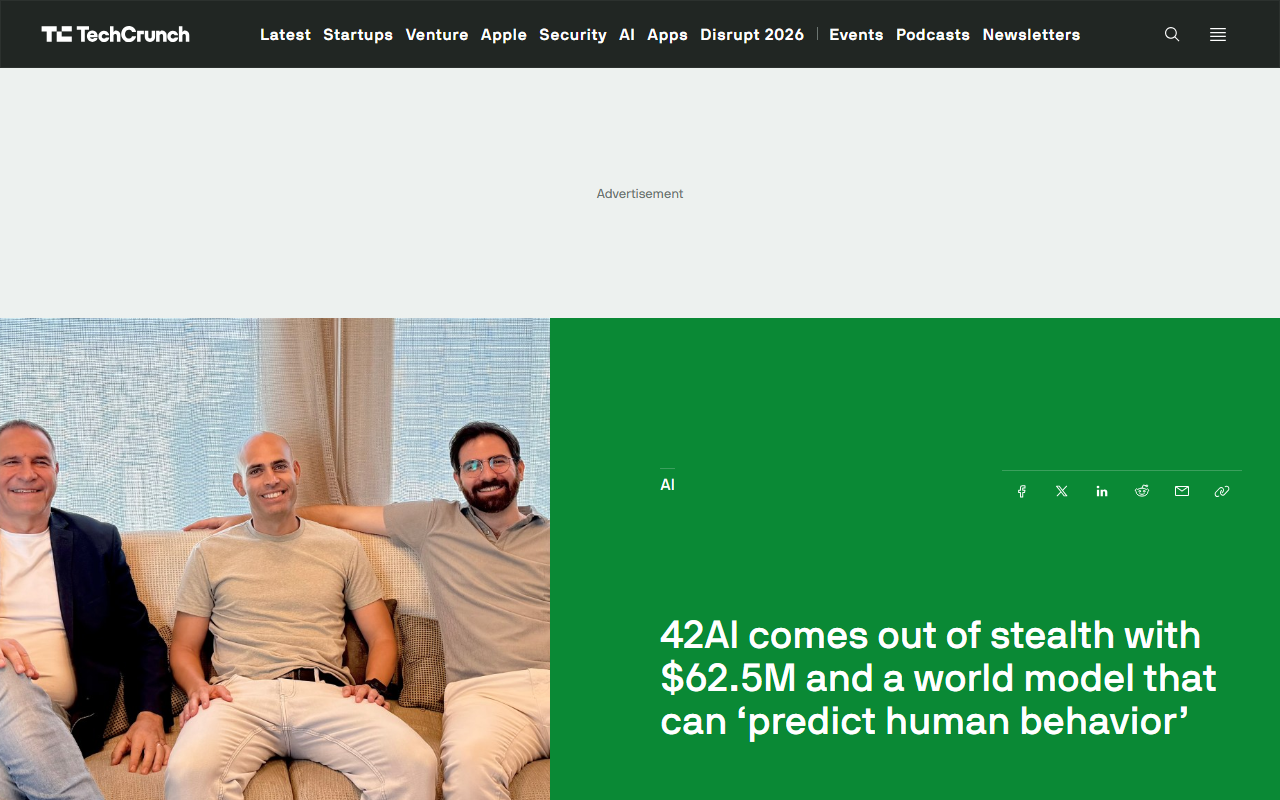
An Israeli startup called 42AI emerged from stealth with a transformer-based "behavioral world model" that estimates the probability of a specific person's choices, even in situations the model has never seen, and no public rule is attached to it yet. It builds that from onboarding records, know-your-customer data, support calls, voice and sentiment analysis, money transfers and trading activity, turned into what the company calls "trait representations." About ten large brokerages already use it to predict how individual traders will react to volatile markets; one reportedly gained around $30 million through dynamic hedging.
The training data is the part that should stop you. It began with psychological assessments of thousands of people, added government and biobank datasets covering more than two million, and 42AI says its customer datasets now cover almost thirty million people. The company insists "the model never knows who the person is" and needs no personally identifiable information, yet it's still building an individual profile from your linked activity. Asked whether a brokerage could use a forecast of its own customer's behavior against that customer, co-founder Ehud Ezra called it "a valid concern," then pointed to regulation and an internal ethics committee without saying what would actually stop it. We covered Daniel Solove's argument in July, that letting people "control" their data is a weak substitute for holding companies accountable. With 42AI, your consent to share data does nothing: the profile gets built from your activity whether you agree or not.
Why this matters: A company you've never heard of may already be modeling how you'll behave, assembled from the financial activity your bank and brokerage already hold. The "we never know your name" line sounds reassuring until you look at it: a profile built from your linked activity is a profile of you, name or not.
Action this week: Ask any bank, brokerage or app that holds your financial data whether it uses third-party behavioral-prediction models, and what it does with a forecast of your choices. "We don't store your name" is a smaller promise than it sounds, because the profile that matters is built from your activity, not your name. A company that predicts your behavior shouldn't get to trade on that prediction against you, full stop. Watch the state financial-privacy and AI-profiling bills that would force disclosure.
Listen to the Daily Signal podcast at pickbits.ai/daily-signal.
3. Goldman Sachs restricted Claude Code and GitHub Copilot to its engineers only.
A spokesperson said the "experimentation phase" is over, reversing the "vibe coding" pitch the bank's own CIO made in July.
Goldman Sachs cut most of its employees off from advanced AI coding tools, Anthropic's Claude Code and Microsoft's GitHub tools among them, and left them to engineers only. Traders and bankers had spent months using the tools to monitor trading flows and build content; a spokesperson said the "experimentation phase" is over and access now goes only to the people "best suited to leverage them for the long term," citing "a variety of factors including productivity and risk management."
Back in July, CIO Marco Argenti was praising "vibe coding" by non-technical staff: a trader has an idea, prototypes it with AI, and hands it to an engineer to scale. The new October guidelines throw that out. This has been building for a while: GitLab shipping tools to govern enterprise AI coding, the UN chief warning the world not to "vibe-code" its future, developers complaining the app stores are filling with AI-written garbage. Goldman is the kind of place that takes risk seriously, and it just put that worry in writing. It's not that AI coding doesn't work. It's that nobody could vouch for what the non-engineers were shipping.
Why this matters: If you've been handed an AI coding tool at work, the firm with the strictest risk rules on Wall Street just decided who should actually be allowed to use one, and cut everyone else off. When I've asked vendors who reviews AI-written code before it ships, the honest answer is usually "the person who prompted it," and that is exactly the arrangement Goldman just ended.
Action this week: Write down who in your shop may use which AI coding tool, and why. Do what Goldman did: give the AI coding tools to the people who can actually read the output, and log everyone else instead of letting every desk vibe-code into production. If you leaned on Claude Code or Copilot to prototype as a non-engineer, assume access can vanish overnight, and keep a human-owned record of what you built and how it works. And if you own your company's AI-tool policy, send this one to whoever signs off on it, with the question to get answered in writing: who reviews the code these tools produce before it reaches anything that matters?
the-decoder.com: Goldman Sachs pulls AI coding tools from traders and bankers (November 2, 2026)
techinasia.com: Goldman Sachs restricts AI coding tools to engineers (November 2026)
4. A one-person biotech used Claude to take a rare-disease drug from idea to animal results.
Anthropic just acquired Mithril Medicine, whose founder Cody Tranbarger, its only full-time employee, got there in under 18 months.
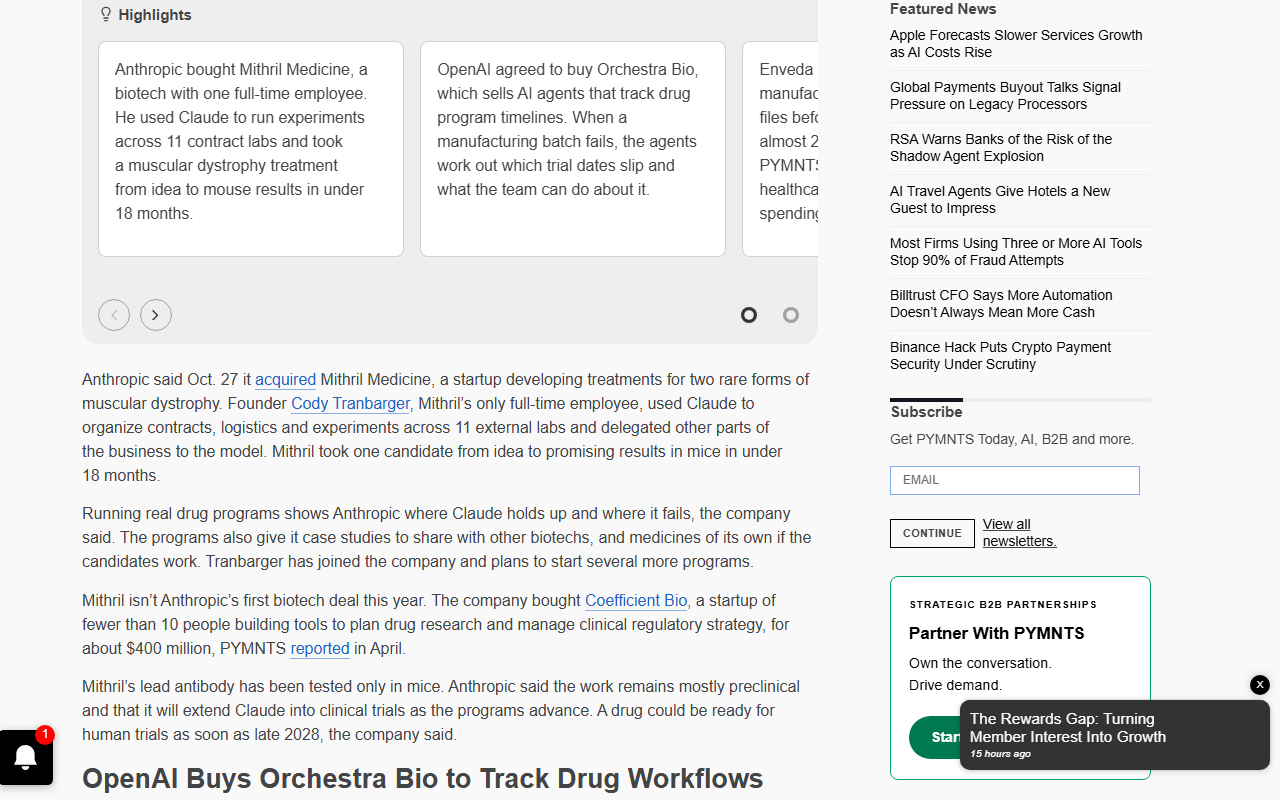
Anthropic just bought a biotech with exactly one employee, and the story is what that one person pulled off. Founder Cody Tranbarger used Claude to organize contracts, logistics and experiments across eleven external contract labs at Mithril Medicine, a Cambridge, Massachusetts rare-disease startup, and took an antibody candidate for two rare forms of muscular dystrophy from idea to promising results in mice in under eighteen months.
This is still early, though. The work is mostly preclinical, the lead candidate has only been tested in mice, and Anthropic says a drug could reach human trials as soon as late 2028 if it keeps holding up. That's years and several hard trials away from anyone it would help. We flagged the direction of this back in July, when Anthropic said at its "AI for Science" briefing that it wanted to develop drugs of its own for "neglected" diseases. The honest caveat then was that the AI drug boom has a long way to go before reaching patients, and it still does. The same announcement laid out Claude-powered drug-discovery partnerships with six organizations, including Bristol Myers Squibb and Generate Biomedicines. And one person, with an AI assistant, did the coordination that used to take a whole company.
Why this matters: A single person, working alone with an AI assistant, just pushed a drug for a rare disease from idea to promising animal results in under eighteen months. What gets me isn't the molecule, because AI didn't invent that. It's that AI did the contracts, the logistics, the eleven-lab juggling that normally needs a whole company, which is the reason a disease this small never gets a team.
Action this week: Study how Mithril actually used an AI assistant, to orchestrate outside labs, logistics and paperwork rather than to "invent" a molecule, because that's how a tiny team stretches to cover a disease too small for big pharma. Say the mice part out loud when you share it: the candidate has only worked in mice, so watch whether it survives real human trials before anyone calls this "AI made a drug." And if you work in a small lab or a rare-disease foundation, send this to whoever decides what your team takes on next.
pymnts.com: Anthropic buys a one-person biotech to prove Claude can make drugs (November 2, 2026)
officechai.com: Anthropic acquires one-person drug-discovery startup Mithril Medicine (November 2026)
» What to watch this week
- Whether OpenAI's statehouse bills start moving after the midterms, and which big states go first. The tell is whether large legislatures begin mirroring near-identical frontier-AI language, which is how a "de facto national standard" gets built without a single federal vote.
- Whether any regulator or lawmaker forces behavioral-prediction models like 42AI's to disclose what they do with a forecast of you. Watch the state financial-privacy and AI-profiling bills; the fight is over disclosure and use limits, not whether the profiling is technically possible.
- Whether other banks and regulated firms copy Goldman's engineers-only line on AI coding tools. When a careful bank moves first, others tend to copy it, the same way the Shopify "prove AI can't do it" memo spread.
- Whether Mithril's muscular-dystrophy candidate clears the jump from mice to human trials. Anthropic's late-2028 trial timeline is the first real checkpoint on whether the one-person-biotech template produces a medicine or just a promising mouse result.
Tomorrow's signal lands here.